
Quick answer: Choose an LED display by answering three questions: how close viewers are (pixel pitch), where it is installed (brightness and IP rating) and whether cameras will film it (refresh rate). Control rooms and meeting rooms need fine pitch P0.9–P1.8; events, churches and exhibitions use P2.5–P3.9; stadiums and billboards use P4–P10 with 5,000+ nits and IP65.
3 Questions to Choose the Right LED Display
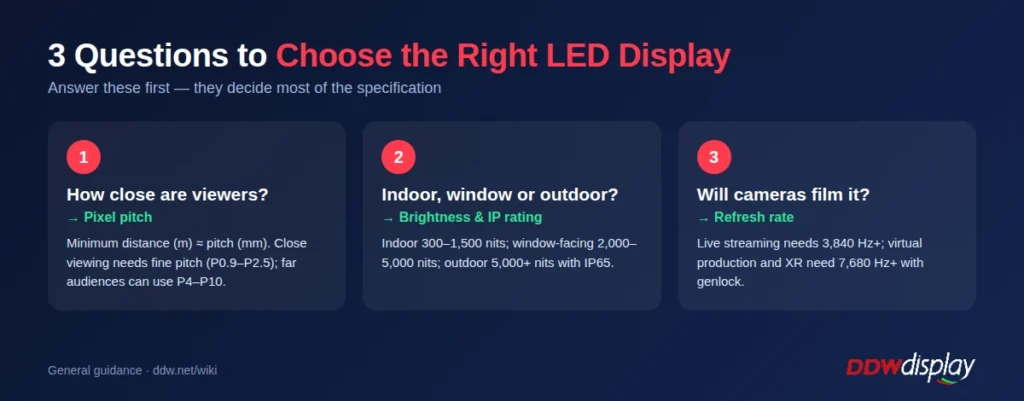
- How close are the viewers? This decides LED display pixel pitch: the minimum viewing distance in meters is roughly the pitch in millimeters.
- Indoor, window-facing or outdoor? This decides brilho e Classificação IP: indoor 300–1,500 nits, window-facing 2,000–5,000 nits, outdoor 5,000+ nits with IP65.
- Will cameras film it? This decides taxa de atualização: 3,840 Hz+ for streaming, 7,680 Hz+ with genlock for XR.
LED Display Selection Table by Application
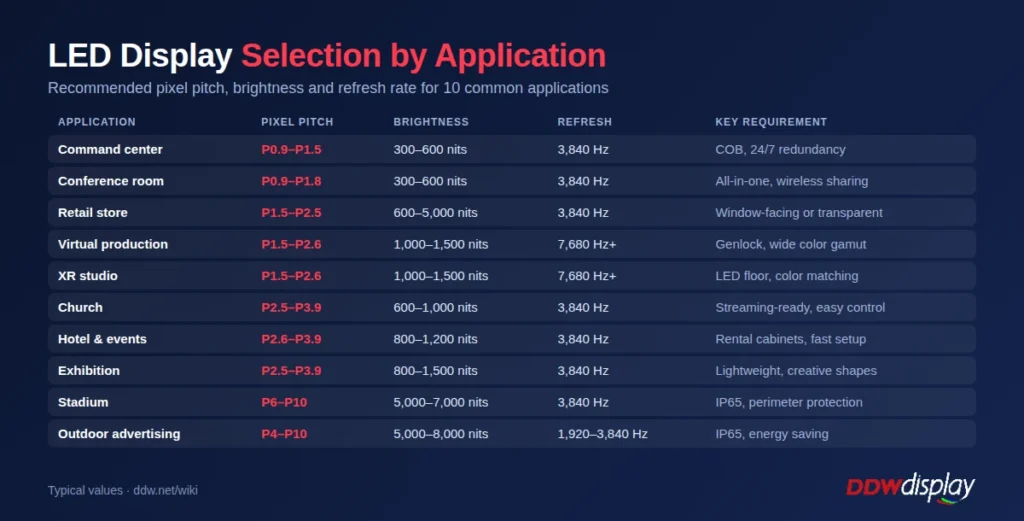
| Candidatura | Distância entre Pixels | Brilho | Refresh Rate | Key Requirement |
|---|---|---|---|---|
| Command center | P0.9–P1.5 | 300–600 nits | 3,840 Hz | COB, 24/7 redundancy |
| Conference room | P0.9–P1.8 | 300–600 nits | 3,840 Hz | All-in-one, wireless sharing |
| Retail store | P1,5–P2,5 | 600–5,000 nits | 3,840 Hz | Window-facing or transparent |
| Virtual production | P1.5–P2.6 | 1,000–1,500 nits | 7,680 Hz+ | Genlock, wide color gamut |
| XR studio | P1.5–P2.6 | 1,000–1,500 nits | 7,680 Hz+ | LED floor, color matching |
| Igreja | P2,5–P3,9 | 600–1,000 nits | 3,840 Hz | Streaming-ready, easy control |
| Hotel and events | P2.6–P3.9 | 800–1,200 nits | 3,840 Hz | Rental cabinets, fast setup |
| Exhibition | P2,5–P3,9 | 800–1,500 nits | 3,840 Hz | Lightweight, creative shapes |
| Estádio | P6–P10 | 5,000–7,000 nits | 3,840 Hz | IP65, perimeter protection |
| Outdoor advertising | P4–P10 | 5,000–8,000 nits | 1,920–3,840 Hz | IP65, energy saving |
Indoor LED Display Applications
Indoor projects are driven by close viewing. Command center LED video walls e conference room LED displays use fine pitch COB for 24/7 reliability and sharp text. Retail LED displays mix in-store walls with bright window screens or LED transparente. Church LED screens, hotel and event screens e exhibition LED walls balance size, cost and flexible setup at P2.5–P3.9.
Outdoor LED Display Applications
Outdoor screens are viewed from farther away but must fight sunlight and weather. Outdoor advertising LED billboards use P4–P10 with 5,000–8,000 nits, IP65 and energy-saving design, while stadium LED displays add perimeter boards with impact protection and broadcast-ready refresh rates. See the outdoor LED screen pixel pitch guide for details.
Camera-Based LED Applications: XR and Virtual Production
LED walls for virtual production e XR studio LED walls are filmed directly, so refresh rate, genlock, color accuracy and moiré control matter more than raw brightness. Typical pitches are P1.5–P2.6 — see pixel pitch for XR LED walls.
Budget, Installation and Service Considerations
- Orçamento: finer pitch raises cost quickly; pick the largest pitch that still looks smooth at your closest viewing distance.
- Installation: wall-mounted, flown, ground-stacked or curved — see LED screen installation cost and timeline.
- Service access: choose front service when there is no rear walkway.
- Lifecycle: order spare parts and plan maintenance from day one.
DDW Engineer Notes: Choosing an LED Display by Application
Most specification mistakes come from choosing pixel pitch by habit rather than by viewing distance, or ignoring camera requirements until the first live stream. Share your room size, viewing distance, installation site and content with our engineers and we will recommend a configuration that fits the application and budget.
FAQ
How do I choose an LED display for my application?
Start with viewing distance (pixel pitch), environment (brightness and IP rating) and whether cameras will film the screen (refresh rate); then consider size, installation and budget.
What LED display is best for indoor use?
Indoor applications typically use P0.9–P3.9 with 300–1,500 nits; fine pitch COB suits control rooms and meeting rooms, while rental cabinets suit events.
What LED display is best for outdoor use?
Outdoor applications use P4–P10 with 5,000+ nits brightness and IP65 protection, such as billboards and stadium screens.
Do I need a high refresh rate LED display?
Yes if the screen will be filmed or streamed: 3,840 Hz or more for live video, and 7,680 Hz+ with genlock for XR and virtual production.
Related LED Display Guides
- LED display price per square meter
- How to choose LED screen pixel pitch
- LED display pixel pitch chart
- Indoor vs outdoor LED display
- COB vs SMD vs GOB vs MIP comparison
- LED display vs LCD video wall
- LED display buying guide checklist
- LED display price factors
Recommended DDW products: KCOB Series COB LED video wall · Ecrã LED de aluguer da Série A · FA Series outdoor LED screen