
Quick answer: A naked-eye 3D LED display creates a 3D effect without glasses by combining an L-shaped corner or curved LED screen with forced-perspective content designed for a specific viewing zone. Outdoor 3D billboards typically use P4–P10 at 5,000+ nits, while indoor 3D displays in retail and exhibitions use P1.5–P3 — and custom 3D content is as important as the screen itself.
How Naked-Eye 3D LED Displays Work
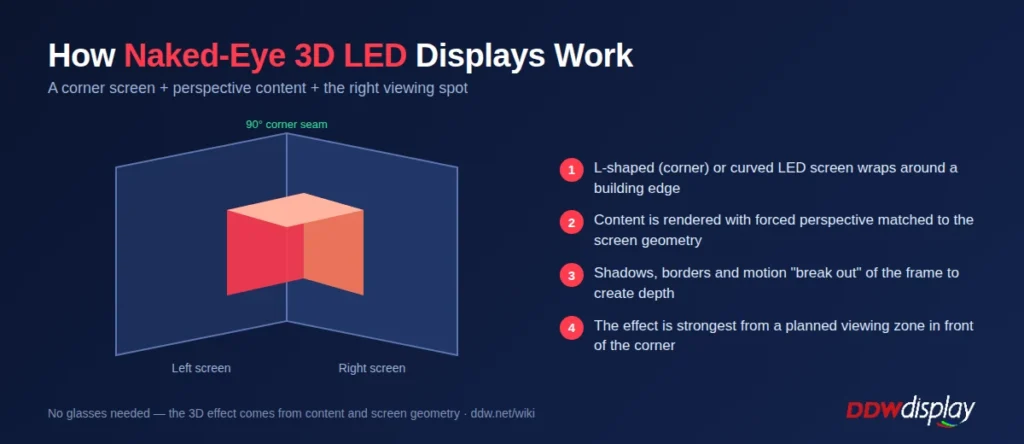
- An L-shaped (about 90°) corner or curved LED screen wraps around a building edge or wall.
- Content is rendered with forced perspective that matches the screen geometry exactly.
- Shadows, frames and motion that “break out” of the screen create a sense of depth.
- The effect is strongest from a planned viewing zone in front of the corner.
Why Naked-Eye 3D LED Is Trending
Naked-eye 3D billboards turn outdoor advertising into shareable moments: passers-by film them and share on social media, extending reach far beyond the street. Brands use them for launches in city centers, while retail digitalization brings smaller 3D displays into malls and flagship stores. Better refresh rates, higher grayscale and more affordable 3D content production are making the format accessible to more projects.
Naked-Eye 3D LED Display Requirements
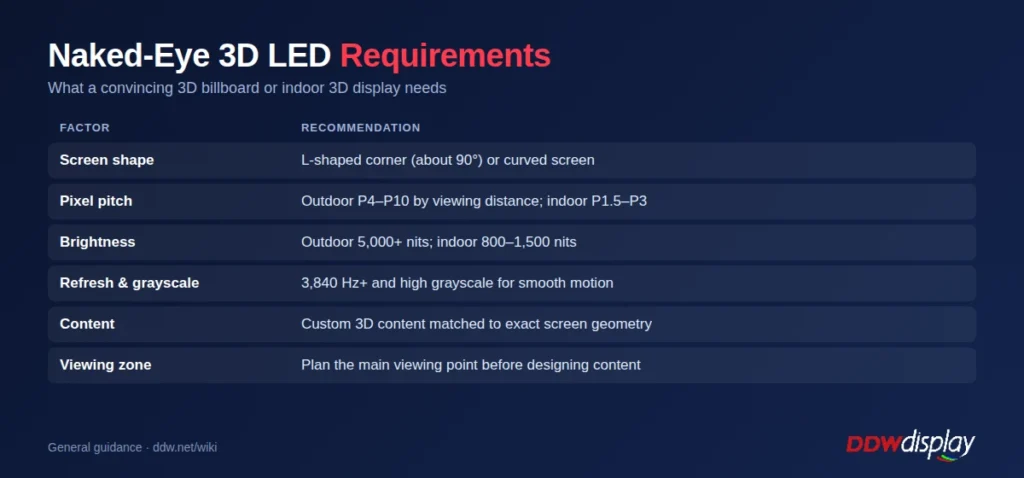
| Factor | Recommendation |
|---|---|
| Screen shape | L-shaped corner (about 90°) or curved screen |
| Pixel pitch | Outdoor P4–P10 by viewing distance; indoor P1.5–P3 (see pixel pitch chart) |
| Luminosità | Outdoor 5,000+ nits; indoor 800–1,500 nits (see LED display brightness) |
| Refresh and grayscale | 3,840 Hz+ and high grayscale for smooth motion |
| Contenuto | Custom 3D content matched to exact screen geometry |
| Viewing zone | Plan the main viewing point before designing content |
Outdoor 3D Billboards vs Indoor 3D LED Displays
Outdoor 3D billboards sit on building corners in busy streets, using large-pitch, high-brightness screens with IP65 protection — see outdoor advertising LED displays. Indoor 3D LED displays in malls, showrooms and mostre use finer pitch for closer viewing and often combine with flexible LED for creative shapes.
Cost Considerations for Naked-Eye 3D LED
Budget covers three parts: the corner or curved LED screen (premium 3D and creative displays can exceed $3,000 per m² — see the LED display price guide), the structure and installation on the building, and custom 3D content production, which must be recreated for each campaign.
DDW Engineer Notes: Naked-Eye 3D LED Displays
The best 3D results come from designing screen and content together: fix the corner angle, seam treatment and main viewing zone first, then produce content for that exact geometry. A tight corner seam and uniform calibration across both faces are essential to keep the illusion convincing.
FAQ
What is a naked-eye 3D LED display?
It is an LED screen, usually L-shaped or curved, that shows specially designed perspective content so objects appear to pop out in 3D without glasses.
Do you need glasses to see naked-eye 3D LED?
No. The 3D effect comes from the screen geometry and forced-perspective content, viewed from a planned viewing zone.
Does naked-eye 3D work on a flat LED screen?
A limited effect is possible with frames and shadows, but corner (L-shaped) or curved screens create a much stronger 3D illusion.
Why is naked-eye 3D content expensive?
Each piece of content must be custom-rendered for the exact screen size, angle and viewing position, which requires specialized 3D production.
Related LED Display Guides
- Retail digitalization with LED displays
- The future of LED displays
- Outdoor advertising LED displays
- Curved LED screen installation
- LED display price per square meter
Recommended DDW products: NOVA Flex Series flexible outdoor LED display · FA Series outdoor LED screen