
Quick answer: An LED video processor receives video sources (HDMI, DP, SDI), scales them to the LED screen’s native resolution, switches and combines inputs, and sends data to the LED screen through built-in sending cards. Key specs are loading capacity, input types, scaling quality, latency, multi-window layout, genlock and HDR support.
Video Processor
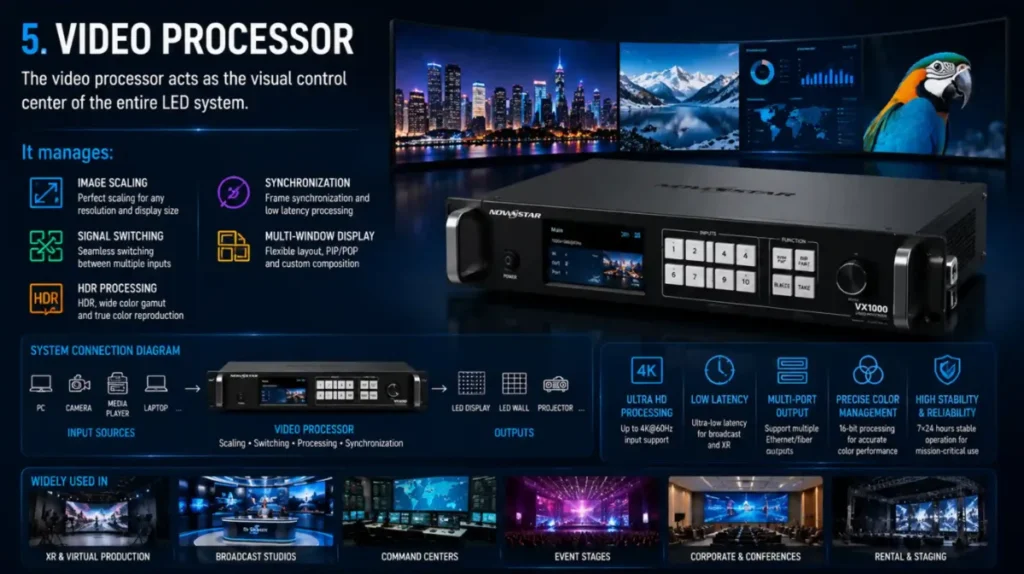
The video processor acts as the visual control center of the entire LED system.
It manages:
- image scaling
- signal switching
- synchronization
- HDR processing
- multi-window display
Why Video Processors Matter So Much
High-end LED systems often involve multiple video sources such as:
- cameras
- media servers
- live production systems
- presentation computers
- XR motori di rendering
The processor ensures these sources display correctly on the LED wall.
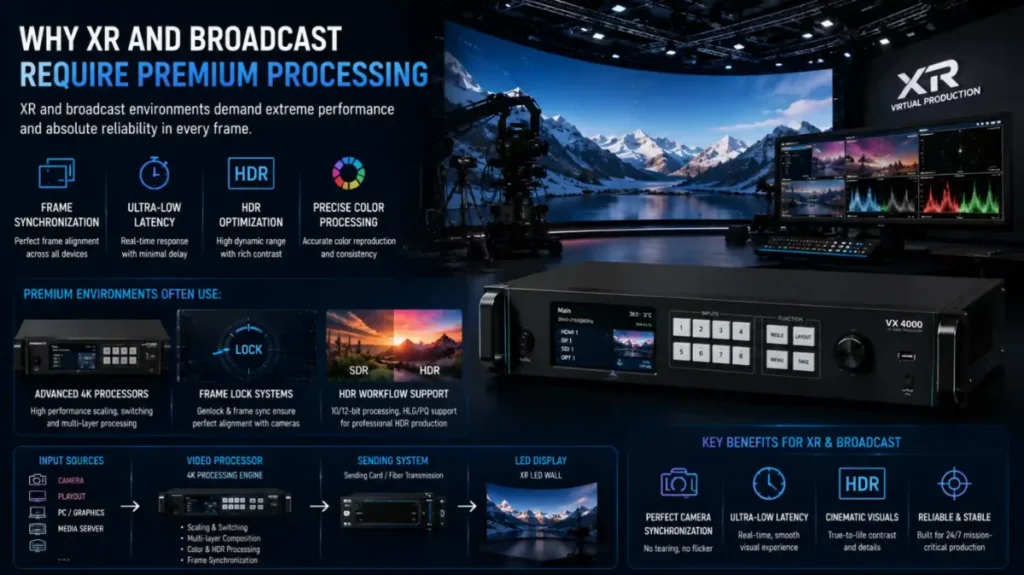
Why XR and Broadcast Require Premium Processing
XR and broadcast environments demand:
- frame synchronization
- ultra-low latency
- Ottimizzazione HDR
- precise color processing
This is why premium environments often use:
- advanced 4K processors
- frame lock systems
- HDR workflow support
Why Scaling Quality Affects Visual Experience
Poor scaling may create:
- blurry image edges
- text distortion
- reduced visual sharpness
This becomes especially visible in:
- sale conferenze
- centri di controllo
- spazi commerciali di lusso
DDW Engineer Notes: LED video processor
Many customers focus heavily on screen specifications while underestimating processor quality.
In reality, image processing architecture often has enormous influence on actual viewing experience.
Especially in premium projects, processing quality directly affects whether a screen feels cinematic or low-end.
Key LED Video Processor Specifications
| Specifiche tecniche | Why It Matters |
|---|---|
| Loading capacity | Must cover the total LED pixel count |
| Inputs | HDMI 2.0, DP, 12G-SDI for 4K sources |
| Scaling quality | Sharp images when source ≠ LED resolution |
| Latency | Low latency for live events and XR |
| Multi-window | Several sources on one screen |
| Genlock and HDR | Camera sync and high dynamic range |
FAQ
Do I need a video processor for an LED screen?
For multiple inputs, scaling or live events, yes; simple fixed-resolution setups may use sending cards only.
What is LED processor loading capacity?
The maximum number of LED pixels the processor can drive, usually listed in millions of pixels.
Why is genlock important for LED processors?
Genlock syncs the LED refresh with cameras to avoid tearing and flicker in XR and broadcast.
Related LED Display Guides
- NovaStar vs Colorlight comparison
- LED sending card guide
- LED video wall resolution calculator
- XR studio LED walls
- HDR LED display color performance
- LED display backup and redundancy
Recommended DDW products: ORBIT XR Series XR LED wall · KCOB Series COB LED video wall