
Quick answer: Ground support installation stacks LED cabinets from the floor using a base frame, truss towers or support bars, instead of hanging them. It is used when the venue cannot carry rigging loads. Stability depends on a level base, rear bracing, ballast and — outdoors — wind straps rated for local conditions.
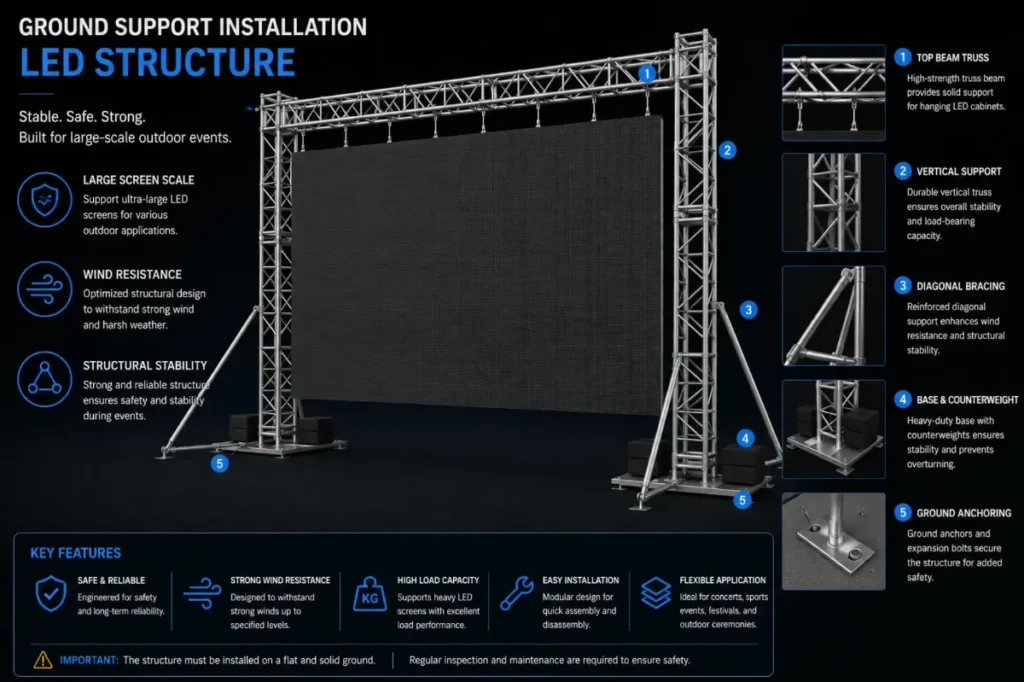
LED-Beleuchtungssysteme für den Bodenbereich werden häufig in folgenden Bereichen eingesetzt:
- im Freien Konzerte
- Sportveranstaltungen
- vorübergehende Phasen
- öffentliche Feste
- Feiern im Freien
Im Vergleich zu Aufhängesystemen werden bei Bodenstützkonstruktionen in der Regel folgende Aspekte vorrangig berücksichtigt:
- großer Bildschirmmaßstab
- Luftwiderstand
- strukturelle Stabilität
Warum die Windlast im Außenbereich so wichtig ist
Große LED-Wände im Außenbereich sind ständigen Umwelteinflüssen ausgesetzt, die von folgenden Faktoren ausgehen:
- Wind
- Vibration
- Wetteränderungen
- Bewegung des Publikums
Eine mangelhafte Konstruktion kann zu ernsthaften Sicherheitsrisiken führen.
Aus diesem Grund müssen professionelle Bodenabfertigungssysteme folgende Anforderungen erfüllen:
- Statikberechnung
- verstärkte Stützsysteme
- angemessener Ballast
- stabile Grundkonstruktion
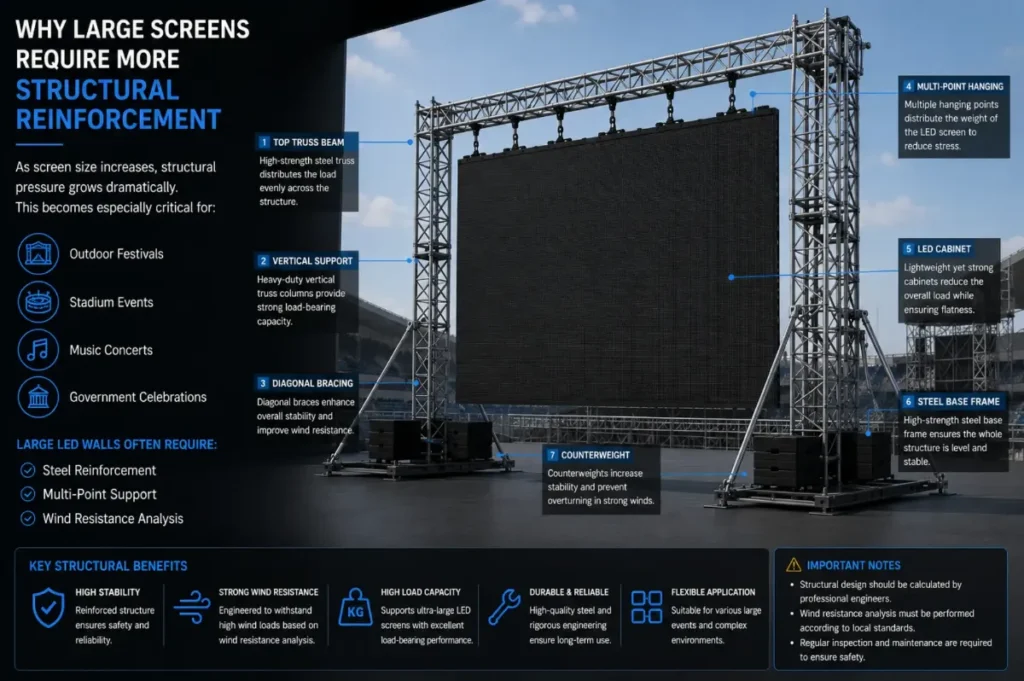
Warum große Bildschirme eine stärkere strukturelle Verstärkung erfordern
Mit zunehmender Bildschirmgröße steigt der strukturelle Druck dramatisch an.
Dies ist insbesondere in folgenden Fällen von entscheidender Bedeutung:
- Open-Air-Festivals
- Veranstaltungen im Stadion
- Musikkonzerte
- staatliche Feierlichkeiten
Große LED-Wände erfordern oft:
- steel reinforcement
- Mehrpunkt-Abstützung
- Windwiderstandsanalyse
Ground Support Setup Steps
- Level the base plates or ground frame on firm, flat ground.
- Erect rear truss towers or support bars to the required height.
- Stack cabinets from the bottom row upward, locking each connection.
- Add rear braces and ballast according to screen height and wind exposure.
- Outdoors, use wind straps and plan to power down and lower the screen in strong wind.
- Check verticality and flatness before connecting power and signal.
DDW Engineer Notes: Ground support LED screen installation
Bei Projekten mit Außenbühnen spielt die Windbeständigkeit oft eine größere Rolle als die Bildschirmauflösung.
Viele bauliche Risiken treten nicht bei normalen Wetterbedingungen auf, sondern bei plötzlichen Umweltveränderungen.
Bei der Planung von Bodenstützkonstruktionen sollte die Sicherheit stets Vorrang vor der optischen Wirkung haben.
FAQ
When should I choose ground support instead of hanging?
Choose ground support when the venue roof or truss cannot carry the LED screen weight, or for outdoor stages without rigging points.
How high can a ground-stacked LED screen be?
Many ground support systems reach about 5–8 m, depending on bracing, ballast and wind load. Taller screens usually need a truss structure.
Is ground support safe outdoors?
Yes, when properly braced, ballasted and wind-strapped. Always follow the wind limits and lower or secure the screen in strong wind.
Related LED Display Guides
- Hanging LED screen installation
- Curved LED screen installation
- Outdoor LED display structure guide
- LED screen transportation and packaging
- LED screen IP rating
Recommended DDW products: Axis Series rental LED screen · LED-Anzeige der A-Serie zur Miete