
Quick answer: XR and virtual production LED walls typically use pixel pitch from P1.5 to P2.6. Smaller pitches reduce moiré when the camera focuses near the wall, while a refresh rate of 3,840–7,680 Hz or higher and very flat cabinets are just as important as pixel pitch.
Pixel Pitch for XR
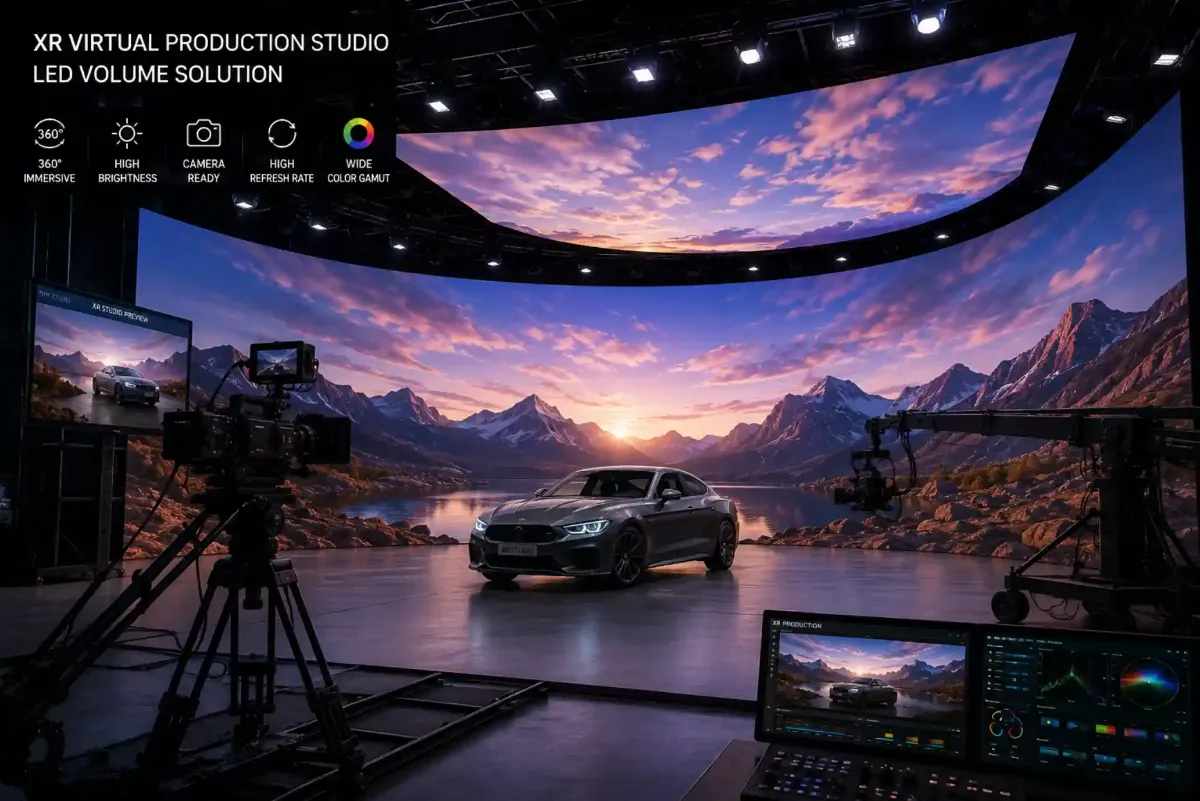
XR virtual production is currently one of the fastest-growing high-end LED applications in the world.
Unlike traditional LED projects, XR environments place extremely high demands on:
- passo dei pixel
- frequenza di aggiornamento
- prestazioni in scala di grigi
- sincronizzazione delle telecamere
- coerenza cromatica
- planarità del mobile
Why XR Requires Smaller Pixel Pitch
In XR studios, cameras may capture LED walls from very close distances.
If pixel pitch is too large, cameras can easily detect:
- struttura dei pixel
- motivi moiré
- image roughness
This directly affects filming quality.
That is why most XR projects today use:
- 2
- 5
- 8
- 3
- 6
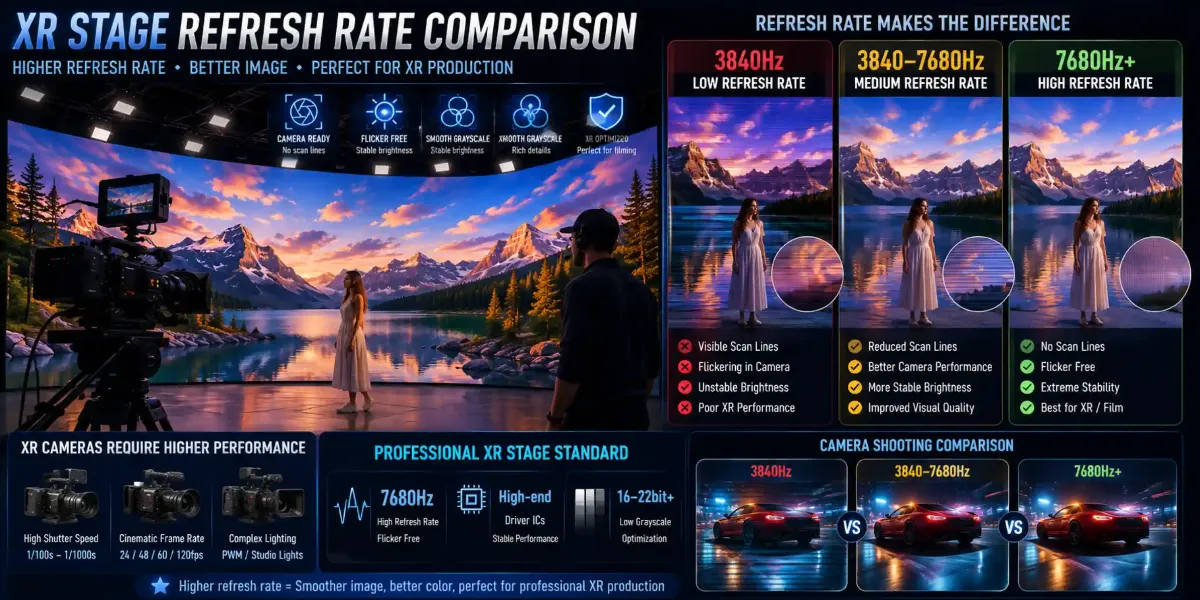
Why Refresh Rate Matters Even More in XR
Many XR cameras use:
- velocità dell'otturatore elevata
- frequenze dei fotogrammi cinematografici
- complex lighting systems
Low refresh rate may cause:
- linee di scansione
- sfarfallio
- luminosità instabile
Most professional XR stages now prefer:
- Frequenza di aggiornamento di 7680 Hz
- high-end driver ICs
- ottimizzazione per immagini in scala di grigi a bassa risoluzione
Cabinet Flatness Is Extremely Important
In XR environments, even small cabinet misalignment may become visible on camera.
This is why XR LED displays usually require:
- armadi in alluminio pressofuso
- precision assembly
- high structural consistency
Cabinet flatness directly affects:
- camera realism
- virtual scene integration
- efficienza nella post-produzione
Why Many XR Projects Prefer Smaller Studios with Fine Pitch
Some customers assume XR always requires giant LED walls.
In reality, many modern virtual production studios prefer:
- smaller stages
- finer pixel pitch
- higher image quality
rather than extremely large but lower-quality setups.
Questo fenomeno è particolarmente comune in:
- commercial filming
- luxury advertising
- servizi fotografici nel settore automobilistico
- ambienti di trasmissione
DDW Engineer Notes: XR LED wall pixel pitch
XR LED projects are completely different from normal rental stages.
Many rental products with acceptable live-event performance may still produce camera issues inside XR studios.
True XR LED systems require careful optimization of:
- frequenza di aggiornamento
- scala di grigi
- camera sync
- planarità del mobile
- modalità di scansione
- calibrazione del colore
XR projects should always be evaluated as professional film production environments, not standard stage displays.
FAQ
What pixel pitch is best for an XR LED wall?
P1.9–P2.6 is common for XR LED walls in medium studios; P1.5 or finer is used when the camera shoots close to the wall.
Why does moiré appear on LED walls in virtual production?
Moiré appears when the camera sensor grid interferes with the LED pixel grid, usually when focus is near the wall or the pitch is too large.
What refresh rate do XR LED screens need?
XR LED screens should have at least 3,840 Hz refresh, and 7,680 Hz or higher is preferred for high-speed cameras and genlock.
Related LED Display Guides
- LED display pixel pitch explained
- LED screen refresh rate
- How to choose LED screen pixel pitch
- P1.5 vs P1.8 vs P2.5 LED display
- LED walls for virtual production
- XR studio LED walls
Recommended DDW products: ORBIT XR Series XR LED wall · D Series rental LED screen