
Quick answer: LED screen power distribution splits the display load across several protected circuits, usually from a three-phase supply through a power distribution cabinet. Design for maximum power but expect average consumption around one-third of maximum, add sequential power-on to avoid inrush current, and ground the system properly.
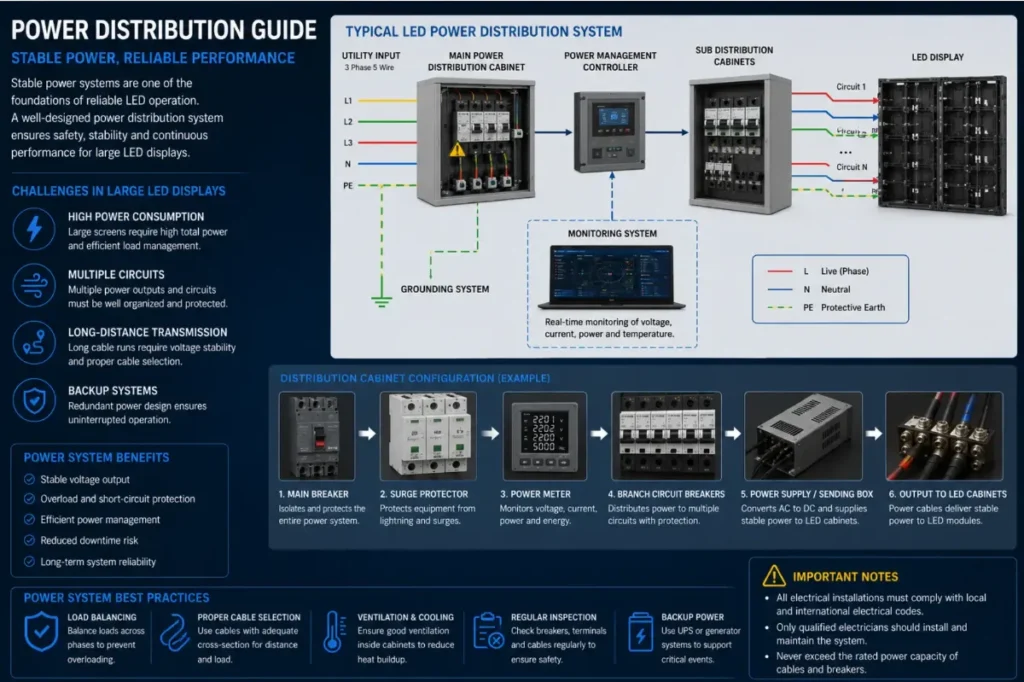
Stable power systems are one of the foundations of reliable LED operation.
Large LED displays often involve:
- high power consumption
- multiple circuits
- long-distance power transmission
- sistemi di backup
Why Power Stability Matters
Unstable power may cause:
- brightness fluctuation
- signal interruption
- power supply damage
- module instability
Ciò assume particolare importanza nei seguenti casi:
- pubblicità esterna
- XR studios
- centri di comando
- live events
Why Large Screens Need Multi-Circuit Distribution
Large LED systems usually divide power across multiple circuits to reduce load pressure.
Professional projects often include:
- circuit balancing
- independent protection
- sistemi di backup
- surge protection
Power Planning Example
A 20 m² outdoor LED display with a maximum power of 800 W/m² needs about 16 kW at peak, while average consumption is typically around 5–6 kW. The load is balanced across three phases, split into several circuits with their own breakers, and switched on in sequence by a power distribution cabinet with surge protection and a ground connection.
DDW Engineer Notes: LED screen power distribution
In many outdoor projects, power quality directly affects long-term display stability.
Especially in regions with unstable electrical infrastructure, proper power distribution becomes extremely important.
FAQ
How much power does an LED screen use?
It varies by product. Indoor LED screens often draw around 150–300 W/m² on average, while outdoor LED displays can average 250–450 W/m² and peak much higher.
Why does an LED display need sequential power-on?
Switching many power supplies on at once creates a large inrush current that can trip breakers. Sequential power-on switches circuits one by one.
Does an LED screen need grounding?
Yes. Proper grounding protects people and electronics, reduces interference and is required for lightning and surge protection.
Related LED Display Guides
- LED display signal connection guide
- Outdoor LED display structure guide
- LED display moisture protection
- LED screen lifespan
- LED screen power supply failure
Recommended DDW products: FC Series energy-saving outdoor LED screen · FA Series outdoor LED screen