
Quick answer: Energy-saving LED displays reduce power consumption through common cathode driving, high-efficiency LED chips, efficient power supplies and automatic brightness control. Together these can cut energy use by roughly 30–50% compared with conventional designs, especially for outdoor LED screens running long hours.
省エネルギー技術
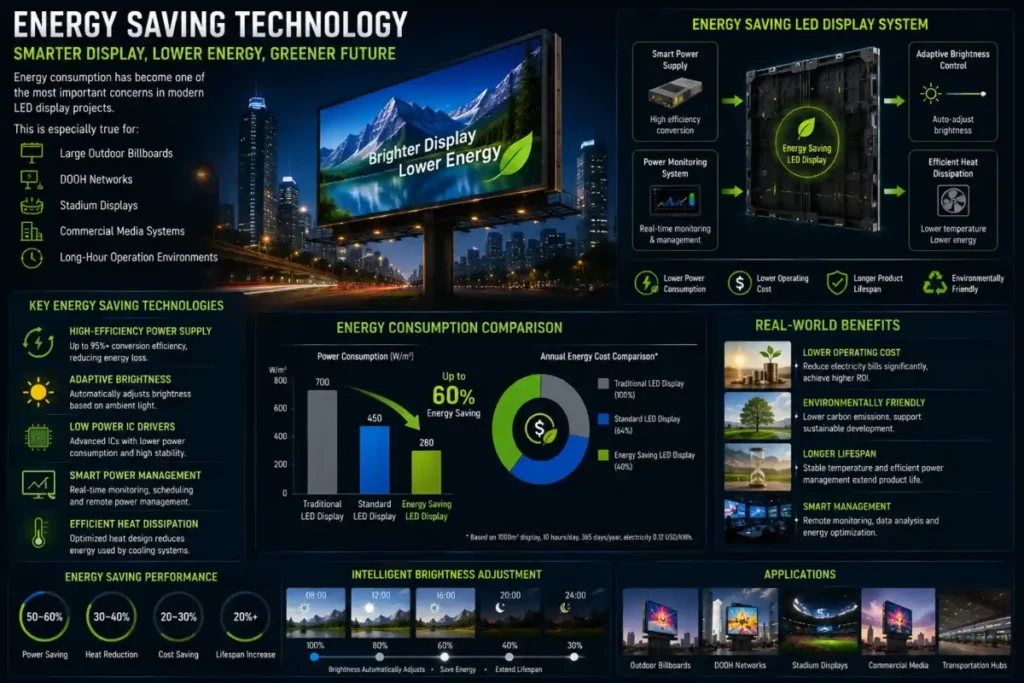
Energy consumption has become one of the most important concerns in modern LED display projects.
これは特に~に当てはまります
- large outdoor billboards
- DOOH networks
- スタジアムのディスプレイ
- commercial media systems
- 長時間稼働環境
Why Energy Efficiency Matters More Today
Large LED projects can consume significant electricity over time.
For long-term operation projects, energy efficiency directly affects:
- operating cost
- 熱 generation
- power system pressure
- environmental impact
This is why many governments and commercial operators now prioritize energy-saving LED systems.
Common Energy-Saving
Methods
Modern LED systems often improve efficiency through:
- 共通陰極 technology
- インテリジェントな輝度調整
- efficient driver ICs
- optimized power supplies
- thermal management optimization
DDW Engineer Notes: Energy-saving LED display technology
In many outdoor projects, heat management and energy consumption are closely connected.
Lower power consumption not only reduces electricity cost, but also helps improve:
- cabinet temperature
- 長期的な安定性
- component lifespan
This becomes especially important in Middle East outdoor installations.
Main Energy-Saving Methods
- Common cathode driving: supplies each color with only the voltage it needs.
- High-efficiency LEDs: more brightness per watt.
- Automatic brightness: light sensors dim the screen at night or in shade.
- Efficient power supplies: higher conversion efficiency and power factor.
- Black-screen power saving: modules idle when showing black content.
FAQ
How much energy can an energy-saving LED display save?
Depending on design and use, energy-saving LED displays commonly save around 30–50% compared with conventional LED screens.
What is the average power consumption of an LED screen?
Average consumption is usually around one-third of maximum power; outdoor LED displays often average 250–450 W/m².
Does energy saving reduce LED brightness?
No. Energy-saving designs aim to deliver the same brightness with less power and lower heat.
Related LED Display Guides
- Common cathode vs common anode LED
- LED display heat dissipation
- LED display brightness (nits)
- LED screen lifespan
- ESG and energy-saving LED displays
Recommended DDW products: FC Series energy-saving outdoor LED screen · FA Series outdoor LED screen