
Quick answer: Energy-saving LED displays reduce power consumption through common cathode driving, high-efficiency LED chips, efficient power supplies and automatic brightness control. Together these can cut energy use by roughly 30–50% compared with conventional designs, especially for outdoor LED screens running long hours.
Energy Saving Technology
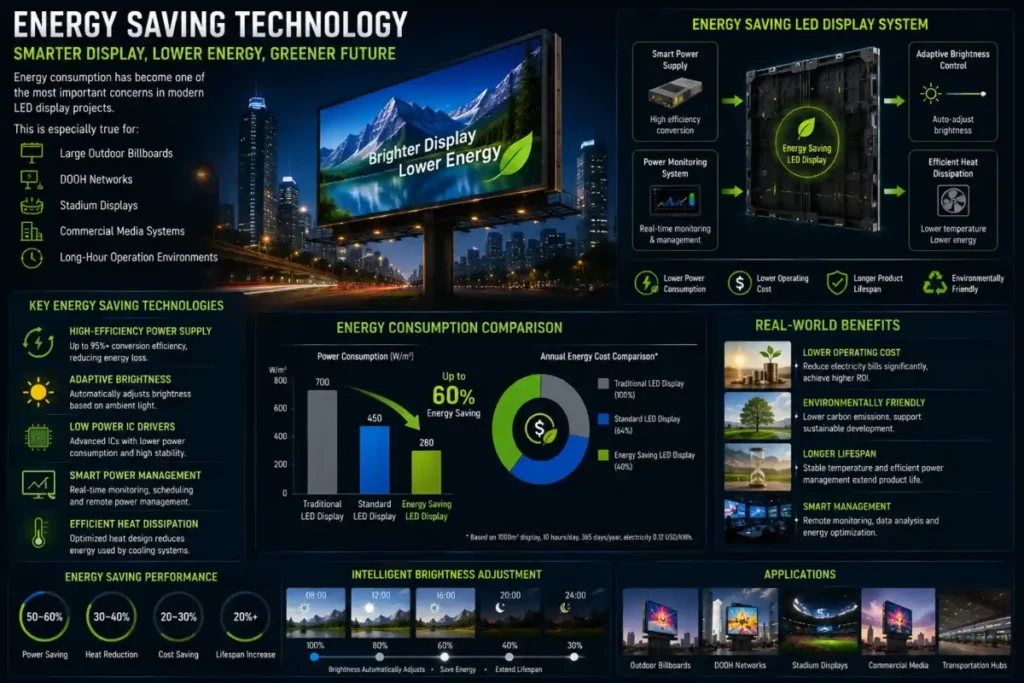
Energy consumption has become one of the most important concerns in modern LED display projects.
وهذا صحيح بشكل خاص لـ:
- large outdoor billboards
- DOOH networks
- شاشات العرض في الملاعب
- commercial media systems
- long-hour operation environments
Why Energy Efficiency Matters More Today
Large LED projects can consume significant electricity over time.
For long-term operation projects, energy efficiency directly affects:
- تكلفة التشغيل
- الحرارة generation
- power system pressure
- الأثر البيئي
This is why many governments and commercial operators now prioritize energy-saving LED systems.
Common Energy-Saving
Methods
Modern LED systems often improve efficiency through:
- common cathode technology
- ضبط السطوع الذكي
- efficient driver ICs
- optimized power supplies
- thermal management optimization
DDW Engineer Notes: Energy-saving LED display technology
In many outdoor projects, heat management and energy consumption are closely connected.
Lower power consumption not only reduces electricity cost, but also helps improve:
- cabinet temperature
- الاستقرار على المدى الطويل
- component lifespan
This becomes especially important in Middle East outdoor installations.
Main Energy-Saving Methods
- Common cathode driving: supplies each color with only the voltage it needs.
- High-efficiency LEDs: more brightness per watt.
- Automatic brightness: light sensors dim the screen at night or in shade.
- Efficient power supplies: higher conversion efficiency and power factor.
- Black-screen power saving: modules idle when showing black content.
FAQ
How much energy can an energy-saving LED display save?
Depending on design and use, energy-saving LED displays commonly save around 30–50% compared with conventional LED screens.
What is the average power consumption of an LED screen?
Average consumption is usually around one-third of maximum power; outdoor LED displays often average 250–450 W/m².
Does energy saving reduce LED brightness?
No. Energy-saving designs aim to deliver the same brightness with less power and lower heat.
Related LED Display Guides
- Common cathode vs common anode LED
- LED display heat dissipation
- LED display brightness (nits)
- LED screen lifespan
- ESG and energy-saving LED displays
Recommended DDW products: FC Series energy-saving outdoor LED screen · FA Series outdoor LED screen