
Quick answer: An HDR LED display shows a wider range between the darkest and brightest parts of an image. It relies on high peak brightness, deep blacks (high contrast), high grayscale bit depth (typically 14–16 bit or more) and a wide color gamut, together with a processor that supports HDR signals such as HDR10.
HDRと色再現性
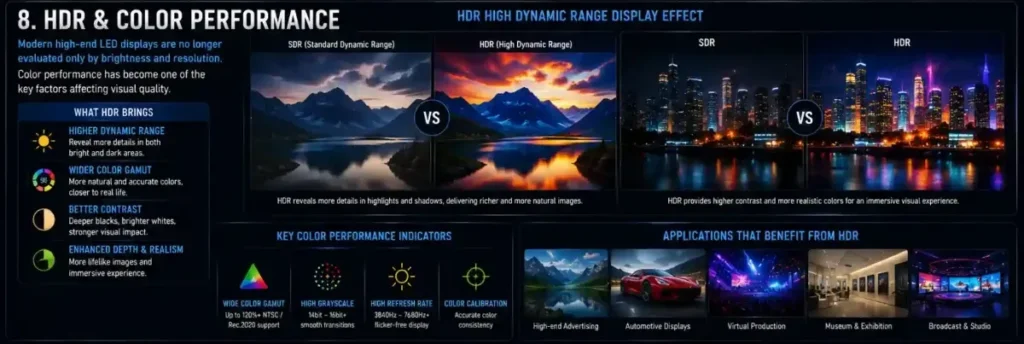
Modern high-end LED displays are no longer evaluated only by 輝度 and resolution.
色再現性は、視覚的な品質に影響を与える重要な要素の一つとなっています。.
HDRが重要な理由
HDR(ハイダイナミックレンジ)により、以下の点が向上します:
- コントラスト
- 影のディテール
- ハイライトの詳細
- 色深度
これにより、よりリアルで没入感のある映像が実現されます。.
HDRが最も重要になる場面
HDRの性能は、特に次のような場面で威力を発揮します:
- XRバーチャルプロダクション
- 放送スタジオ
- 高級小売店のディスプレイ
- 自動車展示会
- 映像コンテンツのプレゼンテーション
こうした環境では、はるかに高い視覚的リアリズムが求められます。.
DDW Engineer Notes: HDR LED display color performance
多くのお客様は、輝度の仕様に特に注目しています。.
しかし、高品質な画質は、多くの場合、以下の要素により大きく左右されます:
- グレースケールの変化
- 色の均一性
- コントラスト調整
- ブラックサーフェスの性能
純粋な輝度出力というよりは。.
Key Specs for LED Color Performance
- Contrast ratio: black LED surfaces (COB, black LEDs) improve contrast.
- Grayscale: 14–16 bit or higher for smooth gradients at low brightness.
- Color gamut: wider gamuts (e.g. QDCOB) show richer colors.
- Calibration: point-by-point calibration keeps color uniform.
- HDR processing: the video processor must support HDR input and tone mapping.
FAQ
What makes an LED display HDR?
High peak brightness, deep blacks, high grayscale bit depth, wide color gamut and HDR-capable processing together make an LED display HDR.
Where does HDR matter most on LED screens?
In broadcast, XR studios, cinema-style content, luxury retail and high-end events where image depth and realism matter.
Does grayscale affect LED image quality?
Yes. Low grayscale causes banding and poor dark detail, especially at low brightness; higher bit depth gives smoother images.
Related LED Display Guides
- QDCOB quantum dot COB LED
- LED screen calibration
- COB LED display technology
- LED screen refresh rate
- Pixel pitch for XR LED walls
Recommended DDW products: QDCOB Series COB LED display · ORBIT XR Series XR LED wall