
Quick answer: An HDR LED display shows a wider range between the darkest and brightest parts of an image. It relies on high peak brightness, deep blacks (high contrast), high grayscale bit depth (typically 14–16 bit or more) and a wide color gamut, together with a processor that supports HDR signals such as HDR10.
HDR und Farbwiedergabe
Modern high-end LED displays are no longer evaluated only by Helligkeit and resolution.
Die Farbwiedergabe ist zu einem der entscheidenden Faktoren für die Bildqualität geworden.
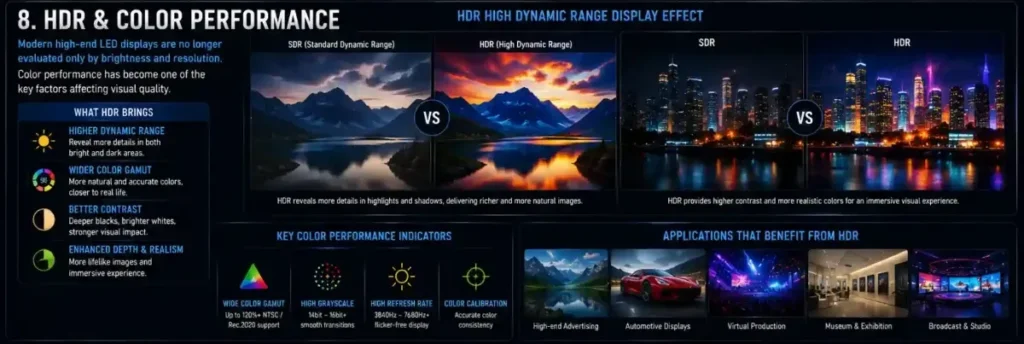
Warum HDR wichtig ist
HDR (High Dynamic Range) verbessert:
- Kontrast
- Schatten-Details
- Details hervorheben
- Farbtiefe
Dadurch entstehen realistischere und eindringlichere Bilder.
Wo HDR am wichtigsten ist
Die HDR-Leistung ist besonders wertvoll in folgenden Bereichen:
- XR-Virtual-Production
- Fernsehstudios
- Luxus-Verkaufsdisplays
- Automobilausstellungen
- Präsentation von Film-Inhalten
Diese Umgebungen erfordern einen deutlich höheren visuellen Realismus.
DDW Engineer Notes: HDR LED display color performance
Viele Kunden legen großen Wert auf die Angaben zur Helligkeit.
Eine erstklassige Bildqualität hängt jedoch oft eher von folgenden Faktoren ab:
- Graustufenübergang
- Farbkonsistenz
- Kontrastregelung
- Leistung auf schwarzer Fahrbahn
anstatt der reinen Lichtleistung.
Key Specs for LED Color Performance
- Contrast ratio: black LED surfaces (COB, black LEDs) improve contrast.
- Grayscale: 14–16 bit or higher for smooth gradients at low brightness.
- Color gamut: wider gamuts (e.g. QDCOB) show richer colors.
- Calibration: point-by-point calibration keeps color uniform.
- HDR processing: the video processor must support HDR input and tone mapping.
FAQ
What makes an LED display HDR?
High peak brightness, deep blacks, high grayscale bit depth, wide color gamut and HDR-capable processing together make an LED display HDR.
Where does HDR matter most on LED screens?
In broadcast, XR studios, cinema-style content, luxury retail and high-end events where image depth and realism matter.
Does grayscale affect LED image quality?
Yes. Low grayscale causes banding and poor dark detail, especially at low brightness; higher bit depth gives smoother images.
Related LED Display Guides
- QDCOB quantum dot COB LED
- LED screen calibration
- COB LED display technology
- LED screen refresh rate
- Pixel pitch for XR LED walls
Recommended DDW products: QDCOB Series COB LED display · ORBIT XR Series XR LED wall