
Quick answer: An HDR LED display shows a wider range between the darkest and brightest parts of an image. It relies on high peak brightness, deep blacks (high contrast), high grayscale bit depth (typically 14–16 bit or more) and a wide color gamut, together with a processor that supports HDR signals such as HDR10.
HDR và hiệu suất màu sắc
Modern high-end LED displays are no longer evaluated only by độ sáng and resolution.
Hiệu suất màu sắc đã trở thành một trong những yếu tố quan trọng ảnh hưởng đến chất lượng hình ảnh.
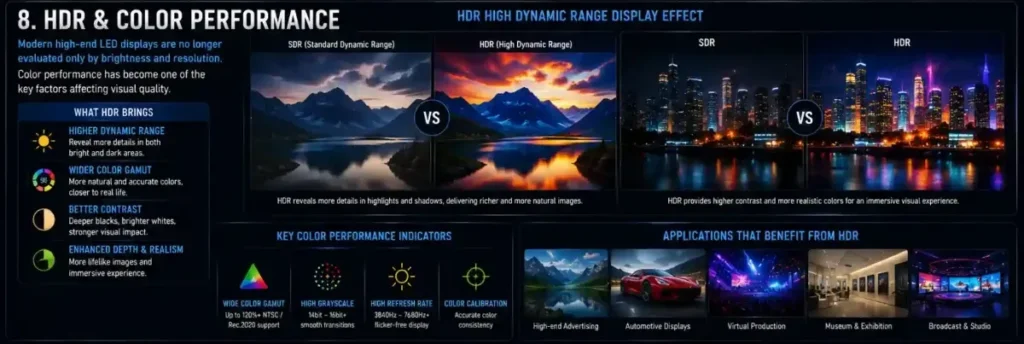
Tại sao HDR lại quan trọng
HDR (Dải động cao) giúp cải thiện:
- sự tương phản
- chi tiết bóng
- chi tiết nổi bật
- độ sâu màu
Điều này giúp tạo ra những hình ảnh chân thực và sống động hơn.
Khi nào HDR trở nên quan trọng nhất
Hiệu suất HDR đặc biệt hữu ích trong các trường hợp sau:
- Sản xuất ảo XR
- phòng thu phát sóng
- kệ trưng bày hàng cao cấp
- triển lãm ô tô
- trình bày nội dung theo phong cách điện ảnh
Những môi trường này đòi hỏi độ chân thực về mặt hình ảnh cao hơn rất nhiều.
DDW Engineer Notes: HDR LED display color performance
Nhiều khách hàng rất chú trọng đến các thông số kỹ thuật về độ sáng.
Tuy nhiên, chất lượng hình ảnh cao cấp thường phụ thuộc nhiều hơn vào:
- hiệu ứng chuyển tiếp thang xám
- độ đồng nhất về màu sắc
- điều chỉnh độ tương phản
- hiệu suất bề mặt màu đen
thay vì chỉ tập trung vào độ sáng thuần túy.
Key Specs for LED Color Performance
- Contrast ratio: black LED surfaces (COB, black LEDs) improve contrast.
- Grayscale: 14–16 bit or higher for smooth gradients at low brightness.
- Color gamut: wider gamuts (e.g. QDCOB) show richer colors.
- Calibration: point-by-point calibration keeps color uniform.
- HDR processing: the video processor must support HDR input and tone mapping.
FAQ
What makes an LED display HDR?
High peak brightness, deep blacks, high grayscale bit depth, wide color gamut and HDR-capable processing together make an LED display HDR.
Where does HDR matter most on LED screens?
In broadcast, XR studios, cinema-style content, luxury retail and high-end events where image depth and realism matter.
Does grayscale affect LED image quality?
Yes. Low grayscale causes banding and poor dark detail, especially at low brightness; higher bit depth gives smoother images.
Related LED Display Guides
- QDCOB quantum dot COB LED
- LED screen calibration
- COB LED display technology
- LED screen refresh rate
- Pixel pitch for XR LED walls
Recommended DDW products: QDCOB Series COB LED display · ORBIT XR Series XR LED wall