
Quick answer: An HDR LED display shows a wider range between the darkest and brightest parts of an image. It relies on high peak brightness, deep blacks (high contrast), high grayscale bit depth (typically 14–16 bit or more) and a wide color gamut, together with a processor that supports HDR signals such as HDR10.
HDR y rendimiento del color
Modern high-end LED displays are no longer evaluated only by brillo and resolution.
El rendimiento cromático se ha convertido en uno de los factores clave que influyen en la calidad visual.
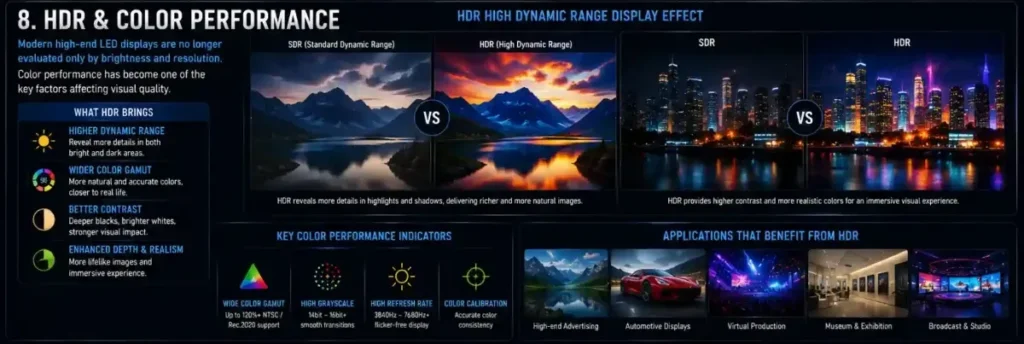
Por qué es importante el HDR
El HDR (alto rango dinámico) mejora:
- contraste
- detalles de las sombras
- destacar detalles
- profundidad de color
Esto permite crear imágenes más realistas y envolventes.
Dónde cobra mayor importancia el HDR
El rendimiento del HDR resulta especialmente valioso en:
- Producción virtual con XR
- estudios de televisión
- escaparates de tiendas de lujo
- ferias del automóvil
- presentación de contenidos cinematográficos
Estos entornos exigen un realismo visual mucho mayor.
DDW Engineer Notes: HDR LED display color performance
Muchos clientes prestan especial atención a las especificaciones de brillo.
Sin embargo, una calidad de imagen óptima suele depender más de:
- transición en escala de grises
- uniformidad del color
- control de contraste
- rendimiento de la superficie negra
en lugar de la potencia luminosa pura.
Key Specs for LED Color Performance
- Contrast ratio: black LED surfaces (COB, black LEDs) improve contrast.
- Grayscale: 14–16 bit or higher for smooth gradients at low brightness.
- Color gamut: wider gamuts (e.g. QDCOB) show richer colors.
- Calibration: point-by-point calibration keeps color uniform.
- HDR processing: the video processor must support HDR input and tone mapping.
FAQ
What makes an LED display HDR?
High peak brightness, deep blacks, high grayscale bit depth, wide color gamut and HDR-capable processing together make an LED display HDR.
Where does HDR matter most on LED screens?
In broadcast, XR studios, cinema-style content, luxury retail and high-end events where image depth and realism matter.
Does grayscale affect LED image quality?
Yes. Low grayscale causes banding and poor dark detail, especially at low brightness; higher bit depth gives smoother images.
Related LED Display Guides
- QDCOB quantum dot COB LED
- LED screen calibration
- COB LED display technology
- LED screen refresh rate
- Pixel pitch for XR LED walls
Recommended DDW products: QDCOB Series COB LED display · ORBIT XR Series XR LED wall