
Quick answer: An HDR LED display shows a wider range between the darkest and brightest parts of an image. It relies on high peak brightness, deep blacks (high contrast), high grayscale bit depth (typically 14–16 bit or more) and a wide color gamut, together with a processor that supports HDR signals such as HDR10.
HDR et rendu des couleurs
Modern high-end LED displays are no longer evaluated only by luminosité and resolution.
Le rendu des couleurs est devenu l'un des facteurs clés qui influent sur la qualité visuelle.
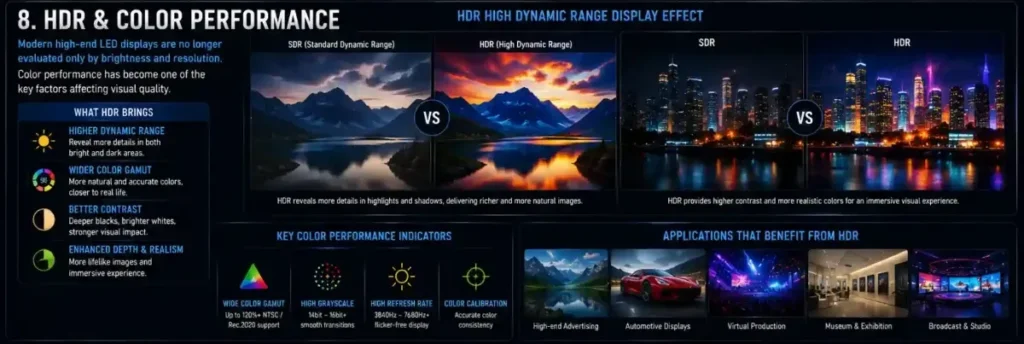
Pourquoi le HDR est-il important ?
La technologie HDR (High Dynamic Range) améliore :
- contraste
- détails des ombres
- détails à mettre en évidence
- profondeur de couleur
Cela permet d'obtenir des images plus réalistes et plus immersives.
Les situations où le HDR prend toute son importance
Les performances HDR sont particulièrement utiles dans les domaines suivants :
- Production virtuelle XR
- studios de télévision
- présentoirs pour le commerce de détail de luxe
- salons automobiles
- présentation de contenus cinématographiques
Ces environnements exigent un réalisme visuel bien plus poussé.
DDW Engineer Notes: HDR LED display color performance
De nombreux clients accordent une grande importance aux caractéristiques techniques relatives à la luminosité.
Cependant, une qualité d'image exceptionnelle dépend souvent davantage des éléments suivants :
- transition en niveaux de gris
- uniformité des couleurs
- réglage du contraste
- performances de la surface noire
plutôt que la luminosité pure.
Key Specs for LED Color Performance
- Contrast ratio: black LED surfaces (COB, black LEDs) improve contrast.
- Grayscale: 14–16 bit or higher for smooth gradients at low brightness.
- Color gamut: wider gamuts (e.g. QDCOB) show richer colors.
- Calibration: point-by-point calibration keeps color uniform.
- HDR processing: the video processor must support HDR input and tone mapping.
FAQ
What makes an LED display HDR?
High peak brightness, deep blacks, high grayscale bit depth, wide color gamut and HDR-capable processing together make an LED display HDR.
Where does HDR matter most on LED screens?
In broadcast, XR studios, cinema-style content, luxury retail and high-end events where image depth and realism matter.
Does grayscale affect LED image quality?
Yes. Low grayscale causes banding and poor dark detail, especially at low brightness; higher bit depth gives smoother images.
Related LED Display Guides
- QDCOB quantum dot COB LED
- LED screen calibration
- COB LED display technology
- LED screen refresh rate
- Pixel pitch for XR LED walls
Recommended DDW products: QDCOB Series COB LED display · ORBIT XR Series XR LED wall