
Quick answer: An HDR LED display shows a wider range between the darkest and brightest parts of an image. It relies on high peak brightness, deep blacks (high contrast), high grayscale bit depth (typically 14–16 bit or more) and a wide color gamut, together with a processor that supports HDR signals such as HDR10.
HDR и цветопередача
Modern high-end LED displays are no longer evaluated only by яркость and resolution.
Цветопередача стала одним из ключевых факторов, влияющих на качество изображения.
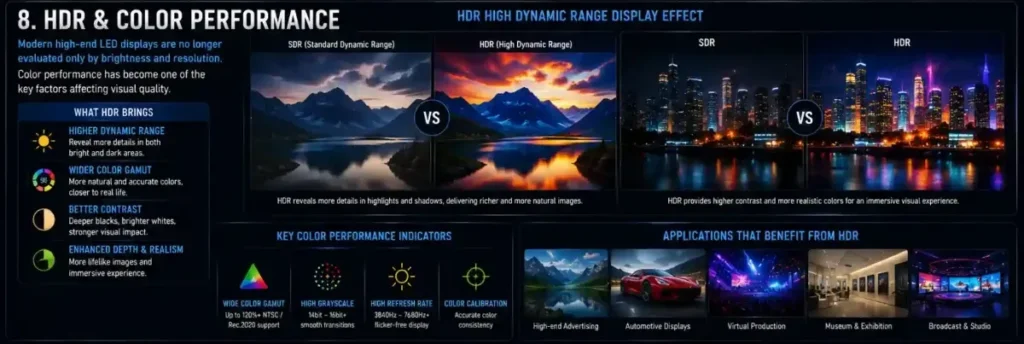
Почему HDR так важен
Технология HDR (High Dynamic Range) позволяет улучшить:
- контраст
- детали тени
- подробная информация о выделенных элементах
- глубина цвета
Благодаря этому изображение становится более реалистичным и захватывающим.
Где HDR играет наиболее важную роль
Возможности HDR особенно ценны в следующих случаях:
- Виртуальная съемка с использованием технологии XR
- телестудии
- роскошные витрины для розничной торговли
- витрины для автомобилей
- презентация кинематографического контента
Такие среды требуют гораздо более высокой степени визуального реализма.
DDW Engineer Notes: HDR LED display color performance
Многие покупатели уделяют особое внимание характеристикам яркости.
Однако высокое качество изображения зачастую в большей степени зависит от следующих факторов:
- переход в оттенках серого
- цветовая стабильность
- регулировка контрастности
- характеристики черной поверхности
а не просто уровень яркости.
Key Specs for LED Color Performance
- Contrast ratio: black LED surfaces (COB, black LEDs) improve contrast.
- Grayscale: 14–16 bit or higher for smooth gradients at low brightness.
- Color gamut: wider gamuts (e.g. QDCOB) show richer colors.
- Calibration: point-by-point calibration keeps color uniform.
- HDR processing: the video processor must support HDR input and tone mapping.
FAQ
What makes an LED display HDR?
High peak brightness, deep blacks, high grayscale bit depth, wide color gamut and HDR-capable processing together make an LED display HDR.
Where does HDR matter most on LED screens?
In broadcast, XR studios, cinema-style content, luxury retail and high-end events where image depth and realism matter.
Does grayscale affect LED image quality?
Yes. Low grayscale causes banding and poor dark detail, especially at low brightness; higher bit depth gives smoother images.
Related LED Display Guides
- QDCOB quantum dot COB LED
- LED screen calibration
- COB LED display technology
- LED screen refresh rate
- Pixel pitch for XR LED walls
Recommended DDW products: QDCOB Series COB LED display · ORBIT XR Series XR LED wall