
Quick answer: COB (Chip on Board) LED displays mount bare LED chips directly on the PCB and seal them under a continuous protective layer. Compared with SMD, COB offers finer pixel pitch (down to about P0.6), stronger impact and moisture resistance, deeper blacks and fewer dead pixels, which makes it the leading choice for fine-pitch indoor LED video walls.
COB Technology
COB (Chip On Board) has become one of the fastest-growing technologies in the fine-pitch LED industry.
Unlike traditional SMD packaging, COB mounts LED chips directly onto the PCB surface, then protects the entire area through advanced encapsulation technology.
This changes not only image quality, but also durability, reliability, and maintenance behavior.
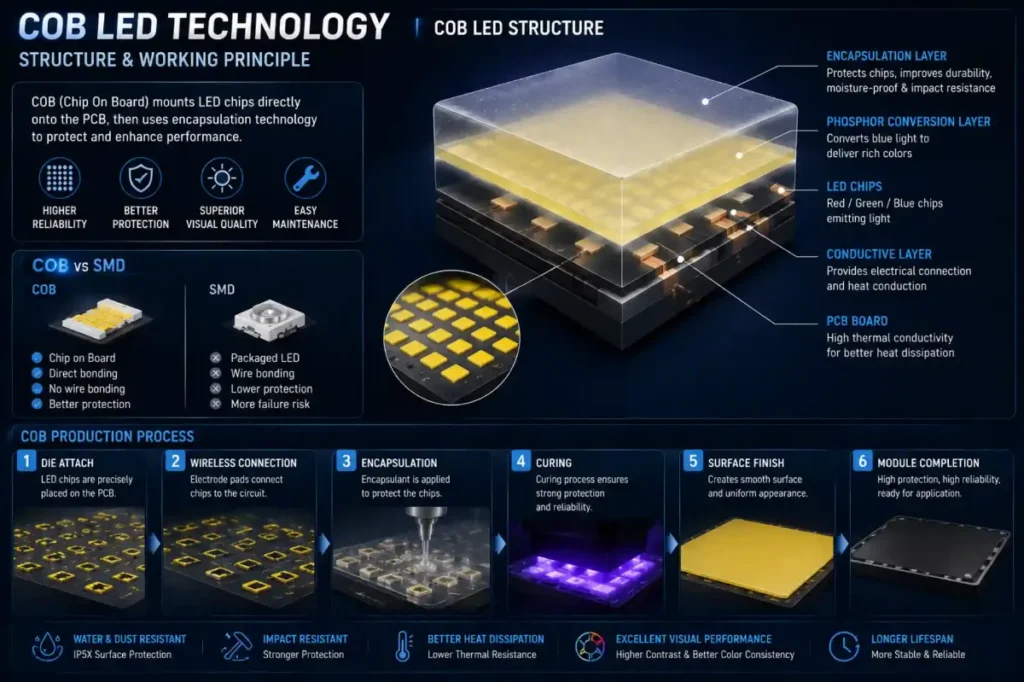
Why More High-End Projects Are Moving Toward COB
Traditional fine-pitch LED displays often face several long-term problems:
- exposed lamp damage
- poor anti-collision performance
- dust accumulation
- moisture sensitivity
- inconsistent black surface appearance
COB technology significantly improves these issues.
This is why COB is becoming increasingly popular in:
- centros de comando
- salas de juntas directivas
- salas de exposición de lujo
- estudios de televisión
- Entornos de realidad extendida
- high-end conference systems
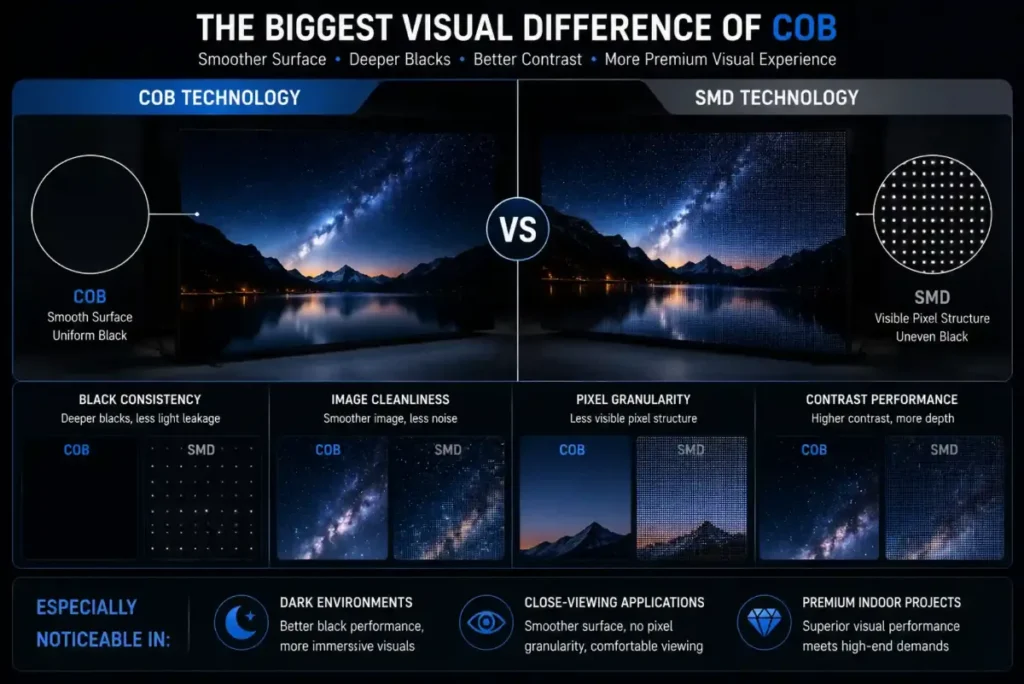
The Biggest Visual Difference of COB
One of the first things customers notice when seeing COB displays is the smoother visual surface.
Compared with traditional SMD:
- black consistency looks better
- image appears cleaner
- pixel granularity becomes less obvious
- contrast performance improves
This becomes especially noticeable in:
- dark environments
- close-viewing applications
- premium indoor projects
Why COB Performs Better in Premium Indoor Projects
Many premium indoor projects involve:
- close viewing distance
- long operating hours
- touch risks
- high-end aesthetics
COB technology helps reduce:
- dead pixel risk
- accidental impact damage
- surface contamination
- maintenance frequency
This is especially valuable in:
- museos
- executive briefing centers
- TV studios
- tiendas de lujo
COB Is Not Only About Image Quality
Many customers initially think COB only improves image sharpness.
In reality, experienced LED engineers often value COB more because of:
- fiabilidad
- protection performance
- estabilidad térmica
- long-term operation
For 24/7 operation environments such as control rooms, these factors are often more important than specifications alone.
DDW Engineer Notes: COB LED display technology
Many customers compare COB and SMD only by visual appearance.
However, the real advantage of COB often appears after years of operation.
In environments with:
- heavy daily usage
- close human interaction
- long operating hours
- premium visual requirements
COB usually provides better long-term stability and lower maintenance risk.
COB vs SMD at a Glance
| Característica | COB | SMD |
|---|---|---|
| Typical pixel pitch | P0.6–P1.9 | P1.2–P10 |
| Surface protection | Sealed, impact and moisture resistant | Exposed LEDs |
| Contraste | Very high (matte black surface) | Bien |
| Repair | Module-level | Single LED |
| Cost at P1.2 and below | More competitive | Higher failure risk |
FAQ
Is COB better than SMD for LED displays?
For fine pitch (about P1.5 and below), COB is usually better thanks to its sealed surface, higher contrast and lower dead-pixel rate. SMD is still more cost-effective for larger pitches.
Can COB LED screens be repaired?
Yes, but typically at module level. Some manufacturers also offer chip-level rework for COB modules.
Where are COB LED displays used?
Control rooms, boardrooms, broadcast studios, luxury retail and other close-viewing indoor applications.
Related LED Display Guides
- COB vs SMD vs GOB vs MIP comparison
- SMD LED display technology
- GOB LED display technology
- MIP LED display technology
- QDCOB quantum dot COB LED
- Fine pitch LED display guide
- COB vs SMD LED display: which to buy
Recommended DDW products: KCOB Series COB LED video wall · QDCOB Series COB LED display