
Quick answer: Heat is a main cause of LED screen failure, color shift and shortened lifespan. LED displays are cooled through aluminum cabinets and module design (passive cooling), fans or air conditioning for enclosed outdoor structures, and energy-efficient designs like common cathode that produce less heat in the first place.
Heat Dissipation
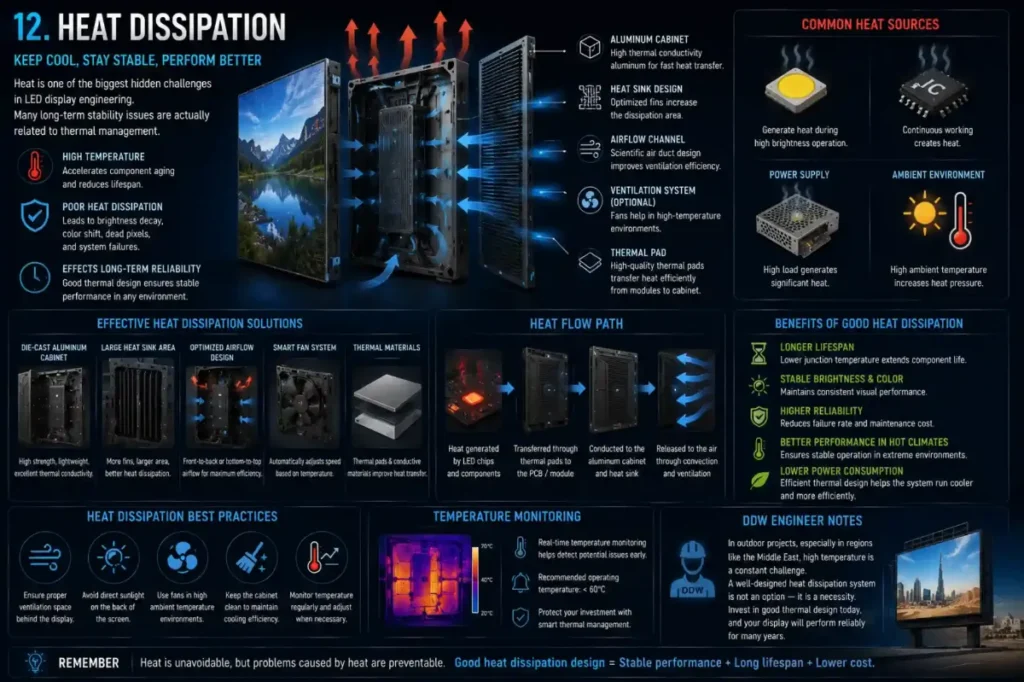
Heat is one of the biggest hidden challenges in LED display engineering.
Many long-term stability issues are actually related to thermal management.
Why Heat Is Such a Big Problem
Why Outdoor Projects Face More Thermal Pressure
Outdoor installations must handle:
- ánh nắng trực tiếp
- high ambient temperature
- enclosed cabinet environments
- continuous operation
Điều này trở nên đặc biệt quan trọng trong:
- Các dự án tại Trung Đông
- tropical regions
- biển quảng cáo có độ sáng cao
Common Heat Dissipation Methods
Professional LED systems usually optimize thermal performance through:
- aluminum structures
- airflow design
- ventilation systems
- energy-efficient circuits
- thermal material optimization
DDW Engineer Notes: LED display heat dissipation
Many outdoor LED failures are not caused by the LED chips themselves.
Instead, overheating often accelerates long-term aging of:
- bộ nguồn
- IC điều khiển
- thẻ nhận
Good thermal management is one of the most important foundations of LED system reliability.
Cooling Methods Compared
| Method | Best For | Notes |
|---|---|---|
| Fanless (passive) | Indoor, rental, fine pitch | Silent; relies on aluminum cabinets |
| Fans | Outdoor cabinets | Need dust filters and maintenance |
| Air conditioning | Enclosed outdoor structures | Controls temperature and humidity |
| Common cathode | All types | Reduces heat at the source |
FAQ
What temperature is safe for an LED display?
Most LED displays operate within about -20 °C to +50 °C ambient; internal temperatures should be kept well below component limits.
Do outdoor LED screens need air conditioning?
Large enclosed outdoor LED structures in hot climates often do; open-back or well-ventilated designs may only need fans.
How does heat affect LED lifespan?
Higher temperatures accelerate LED brightness decay and component aging, shortening the LED screen’s useful life.
Related LED Display Guides
- Common cathode vs common anode LED
- Energy-saving LED display technology
- LED screen lifespan
- LED display brightness (nits)
Recommended DDW products: FC Series energy-saving outdoor LED screen · FA Series outdoor LED screen