
Quick answer: Choose LED screen pixel pitch mainly by the closest viewing distance: in meters it should be at least equal to the pixel pitch in millimeters (e.g. P2.5 → 2.5 m or more). Then check screen size, content type, indoor or outdoor use and budget.
How to Choose Pixel Pitch
Many customers ask:
“Which pixel pitch should I choose?”
In reality, there is no universal answer.
The correct pixel pitch depends on the entire project environment, not just the screen itself.
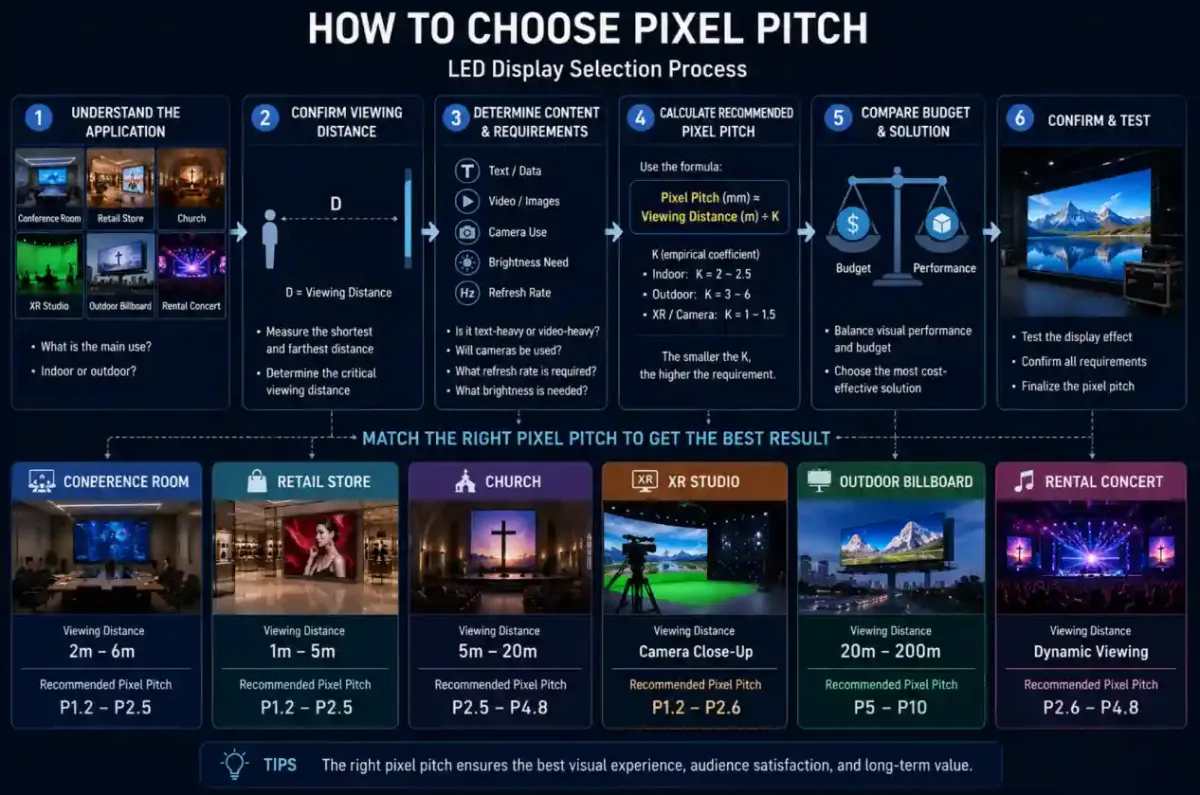
The 5 Most Important Factors
This is usually the first factor engineers evaluate.
Closer viewing requires smaller pitch.
- Indoor or Outdoor
Indoor projects usually use:
- 9–P3.9
Outdoor projects usually use:
- 9–P10
Outdoor environments prioritize:
- luminosité
- imperméabilisation
- distance de visualisation
- Content Type
Text-heavy content requires finer pitch.
Exemples :
- données financières
- conference presentations
- command center dashboards
Video-focused applications can often tolerate larger pitch.
Exemples :
- concerts
- publicité extérieure
- sports events
- Camera Usage
Projects involving:
- XR
- broadcast
- production virtuelle
- diffusion en direct
usually require finer pitch and higher refresh rate.
- Budget Balance
Ultra-fine pitch significantly increases:
- LED cost
- control system cost
- installation complexity
- maintenance difficulty
The goal is not choosing the smallest pitch.
The goal is choosing the most suitable pitch.
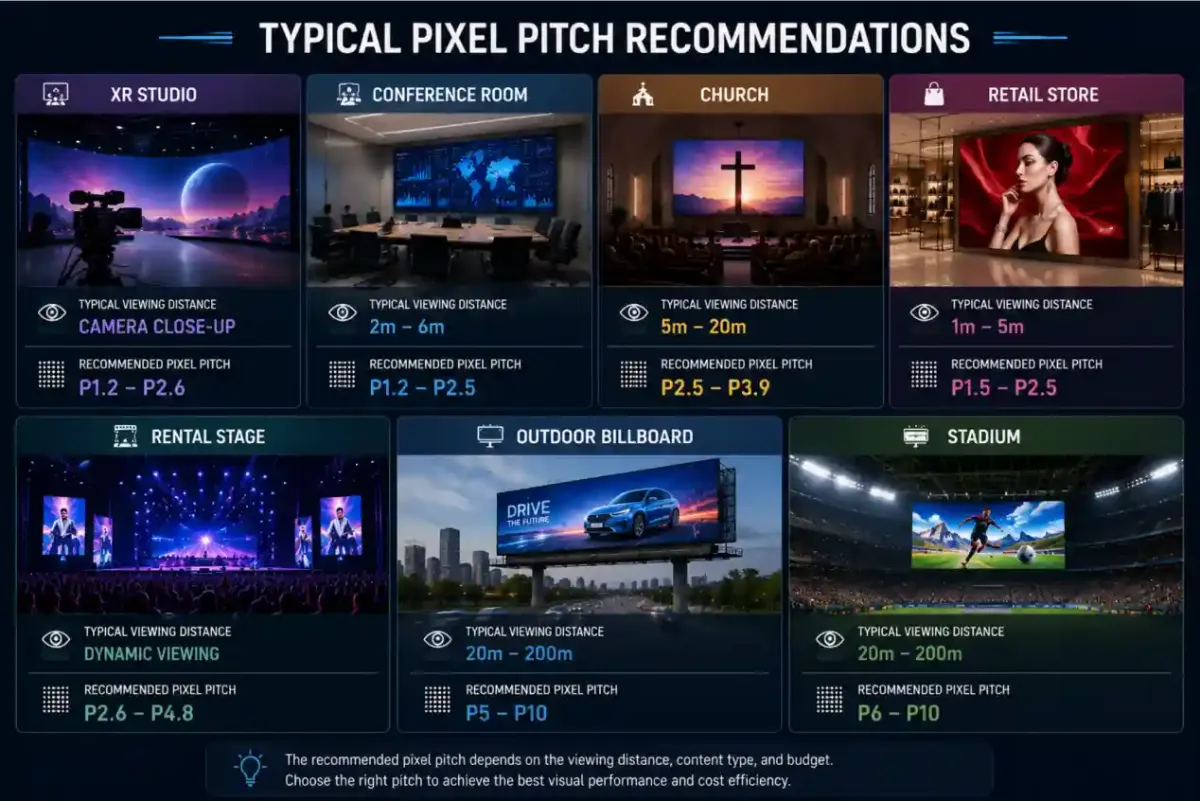
Typical Pixel Pitch Recommendations
Application | Pas recommandé |
XR Studio | P1.2–P2.6 |
Salle de conférence | P1.2–P2.5 |
Église | P2,5–P3,9 |
Magasin de détail | P1.5–P2.5 |
Location de scène | P2.6–P4.8 |
Panneau d'affichage extérieur | P5–P10 |
Stade | P6–P10 |
DDW Engineer Notes: Choosing LED display pixel pitch
In many high-end projects, customers initially choose pitch based only on online specifications.
However, experienced system integrators usually evaluate:
- audience movement
- type de contenu
- ambient light
- camera distance
- installation conditions
- future maintenance
Pixel pitch selection is an engineering decision, not only a specification comparison.
FAQ
What pixel pitch should I choose for a meeting room LED display?
Most meeting room LED displays use P1.2–P1.8 because viewers sit 2–5 m from the screen and read small text.
What pixel pitch is best for a stage LED screen?
Stage and event LED screens usually use P2.6–P3.9, since audiences are several meters away and rental cabinets must balance cost and weight.
Can I use a large pixel pitch to save money?
Yes, if the audience is far enough away. Choosing a pitch smaller than needed can double the LED display cost without a visible improvement.
Related LED Display Guides
- How to choose an LED display by application
- LED display pixel pitch explained
- Best LED screen viewing distance
- P1.5 vs P1.8 vs P2.5 LED display
- Indoor LED display pixel pitch guide
- Outdoor LED screen pixel pitch guide
- LED screen size calculator
- LED display pixel pitch chart
Recommended DDW products: FU Series indoor LED display · FA Series outdoor LED screen