
Quick answer: For buyers, the key differences are cost and specification: outdoor LED displays cost more per m² at the same pitch because they need 5,000+ nits, IP65 protection and stronger power; indoor screens use finer pitch and lower brightness. Semi-outdoor (window-facing) screens sit in between at about 2,000–5,000 nits.
I sistemi LED indoor e outdoor seguono una logica ingegneristica completamente diversa.
Molti acquirenti per la prima volta sottovalutano quanto questi due ambienti siano effettivamente diversi.
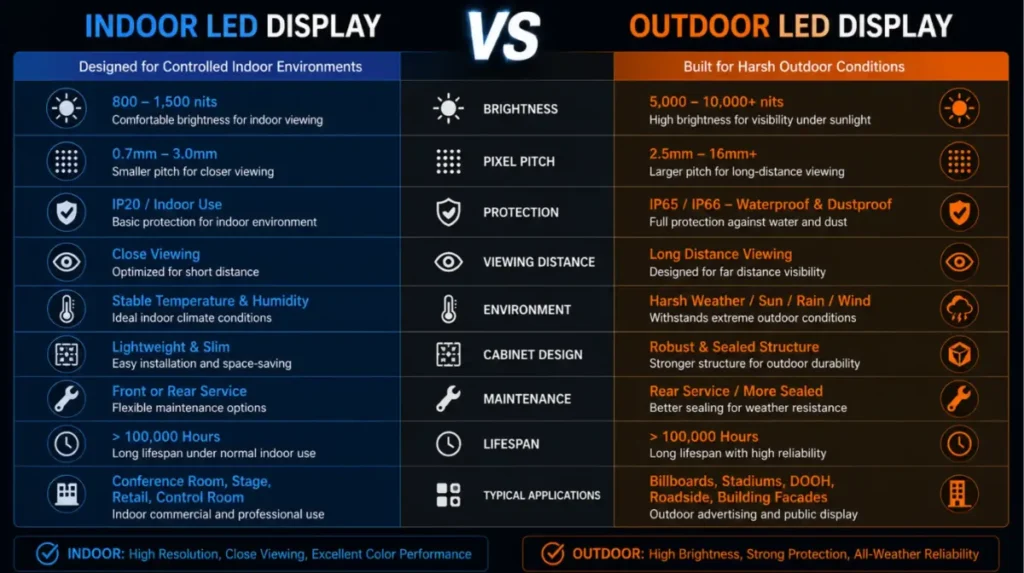
Perché i progetti all'aperto sono molto più impegnativi
I sistemi a LED per esterni devono funzionare continuamente sotto:
- luce solare
- pioggia
- vento
- umidità
- polvere
- temperatura alta
Ecco perché i progetti all'aperto danno priorità:
- Impermeabilizzazione
- dissipazione del calore
- sicurezza strutturale
- high luminosità
Perché i progetti all'interno si concentrano maggiormente sulla qualità visiva
Gli ambienti interni solitamente danno priorità a:
- comodità da vicino
- dettaglio fine dell'immagine
- aspetto elegante
- funzionamento a basso rumore
Ciò è particolarmente importante in:
- sale conferenze
- chiese
- flagship store al dettaglio
- musei
- XR studios
Perché gli standard di luminosità sono completamente diversi
Luminosità interna tipica:
- 600–1200 nit
Luminosità tipica all'aperto:
- 5500–10000 nit
Utilizzare la luminosità esterna all'interno può creare:
- affaticamento degli occhi
- visione scomoda
- eccessivo riverbero
DDW Engineer Notes: Indoor vs outdoor LED display buying
Molti clienti si concentrano principalmente sui rating di impermeabilità quando valutano i prodotti da esterno.
Tuttavia, in ambienti operativi a lungo termine, la gestione termica e la ventilazione sono spesso molto più importanti dell'impermeabilizzazione in sé.
Indoor vs Semi-Outdoor vs Outdoor: What You Pay For
| Spec | Interno | Semi-outdoor | All'aperto |
|---|---|---|---|
| Luminosità | 300–1,500 nits | 2,000–5,000 nits | 5,000–8,000+ nits |
| Protection | IP20–IP30 | IP43–IP54 | IP65 |
| Typical pitch | P0.9–P4 | P2.5–P5 | P3–P10 |
| Power use | Inferiore | Medio | Più alto |
| Cost at same pitch | Inferiore | Medio | Più alto |
FAQ
Is an outdoor LED display more expensive than indoor?
Yes, at the same pixel pitch outdoor screens cost more because of higher brightness, waterproofing and power requirements.
What is a semi-outdoor LED display?
A screen for sheltered or window-facing locations, with 2,000–5,000 nits and moderate protection.
Can I save money using an indoor screen behind a window?
Standard indoor brightness is usually too low in daylight; a semi-outdoor or window-facing LED display is recommended.
Related LED Display Guides
- LED display price per square meter
- Indoor vs outdoor LED displays explained
- LED display price factors
- How to choose an LED display by application
- How to choose LED screen pixel pitch
Recommended DDW products: HK Series HD indoor LED screen · FA Series outdoor LED screen