
Quick answer: SMD (Surface-Mounted Device) packs red, green and blue chips into one LED, enabling fine pixel pitch, wide viewing angles and better color uniformity — the mainstream for indoor and most outdoor LED screens. DIP (Dual In-line Package) uses separate through-hole LEDs with very high brightness, now mainly used in large-pitch outdoor LED displays.
Conoscenze fondamentali
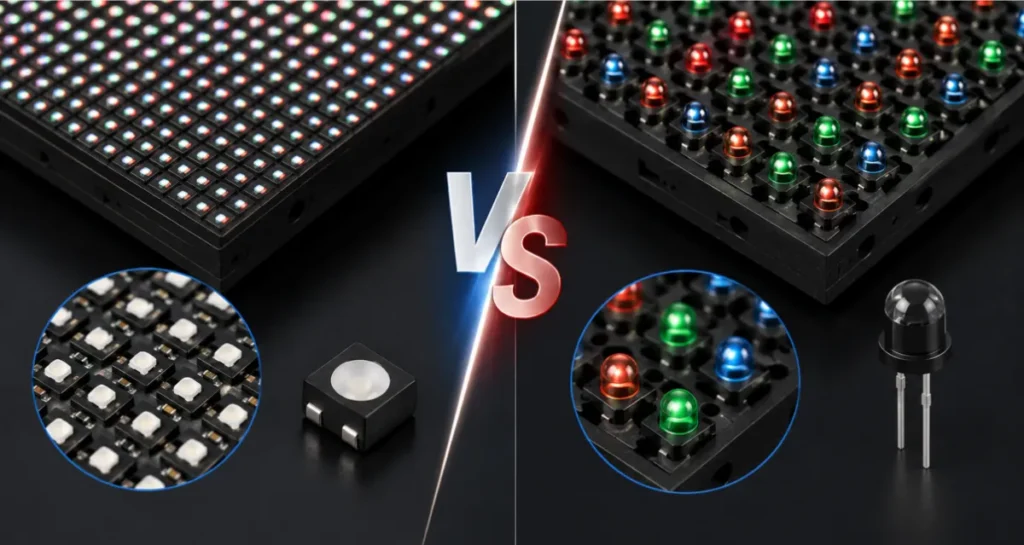
SMD e DIP sono due tecnologie di incapsulamento dei LED comunemente utilizzate nei display a LED.
Ogni tecnologia offre vantaggi diversi a seconda dell'ambiente di applicazione.
Perché la tecnologia SMD è diventata la tecnologia LED più diffusa
L'SMD (Surface Mounted Device) integra chip RGB in un unico contenitore compatto.
Vantaggi:
- Maggiore uniformità dei colori
- Angolo di visione più ampio
- Risoluzione più alta
- Adatto per display da interno con passo di pixel ridotto
Applicazioni comuni:
- Display a LED per interni
- Schermi LED a noleggio
- Sale conferenze
- Ambienti commerciali
Perché il DIP viene ancora utilizzato nei progetti per esterni
Il DIP (Dual In-line Package) utilizza lampade a LED separate montate sul circuito stampato.
Vantaggi:
- Maggiore luminosità
- Better waterproof capability (higher LED screen IP rating)
- Elevata resistenza all'uso all'aperto
Applicazioni comuni:
- Cartelloni pubblicitari all’aperto
- Segnaletica stradale
- Espositori per stadi
Principali differenze
| Caratteristica | SMD | DIP |
| Angolo di visione | Più ampio | Più ristretto |
| Luminosità | Medio | Più alto |
| Risoluzione | Più alto | Inferiore |
| Resistenza all'aperto | Bene | Eccellente |
| Applicazione | Al coperto / All'aperto (a noleggio) | |
Quale tecnologia è più indicata per i progetti concreti?
Quando scegliere SMD:
- È richiesta un'elevata qualità dell'immagine
- Distanza di visione ravvicinata
- Applicazioni in ambienti interni
- Progetti XR o di trasmissione televisiva
Scegli DIP quando:
- È necessaria una luminosità estrema in ambienti esterni
- Osservazione a lunga distanza
- Ambienti esterni difficili

SMD vs DIP vs COB vs MIP
Beyond SMD and DIP, two newer LED packaging technologies now dominate fine-pitch LED display screens:
| Technology | Pitch tipico dei pixel | Strengths | Ideale per |
|---|---|---|---|
| DIP | P10–P20+ | Very high brightness, rugged | Large outdoor billboards |
| SMD | P1.2–P10 | Balanced cost, color and viewing angle | Most indoor and outdoor LED screens |
| LA COB | P0.6–P1.9 | Sealed surface, impact and moisture resistant, deep black | Control rooms, meeting rooms, fine-pitch LED video walls |
| MIP | P0.4–P1.5 | Chip-level sorting for uniformity, repairable | Micro LED displays, broadcast, XR studios |
In short: SMD remains the most cost-effective choice above P1.5, while COB and MIP are the better options for LED displays below P1.2.
DDW Technical Insight: SMD vs DIP LED Screen
La tecnologia SMD domina le moderne applicazioni per interni e nel settore del noleggio, mentre la tecnologia DIP continua a presentare vantaggi negli ambienti esterni ad alta luminosità.
FAQ
Is SMD or DIP better for an LED display?
SMD is better for most LED displays because it offers finer pixel pitch, wider viewing angles and better image quality. DIP is only preferred for very bright, large-pitch outdoor screens.
Why is DIP brighter than SMD?
DIP LEDs use separate, focused red, green and blue lamps that deliver very high brightness, but with narrower viewing angles.
What comes after SMD in LED screen technology?
COB (Chip on Board) and MIP (Mini/Micro LED in Package) are used for fine-pitch LED displays below P1.2 for better protection and contrast.
Related LED Display Guides
- COB vs SMD vs GOB vs MIP comparison
- What is an LED display
- Indoor vs outdoor LED display
- LED screen IP rating
- LED display brightness (nits)
- LED display pixel pitch explained
- COB LED display technology
- MIP LED display technology
Recommended DDW products: FA Series outdoor LED screen · KCOB Series COB LED video wall