
Quick answer: An LED display screen works by grouping red, green and blue LEDs into pixels. A sending card converts the video signal into data, receiving cards distribute it to LED modules, and driver ICs switch each LED on and off thousands of times per second (PWM) to create the image and colors.
Conoscenze fondamentali
I display a LED funzionano controllando milioni di minuscoli LED per creare immagini e video dinamici in tempo reale.
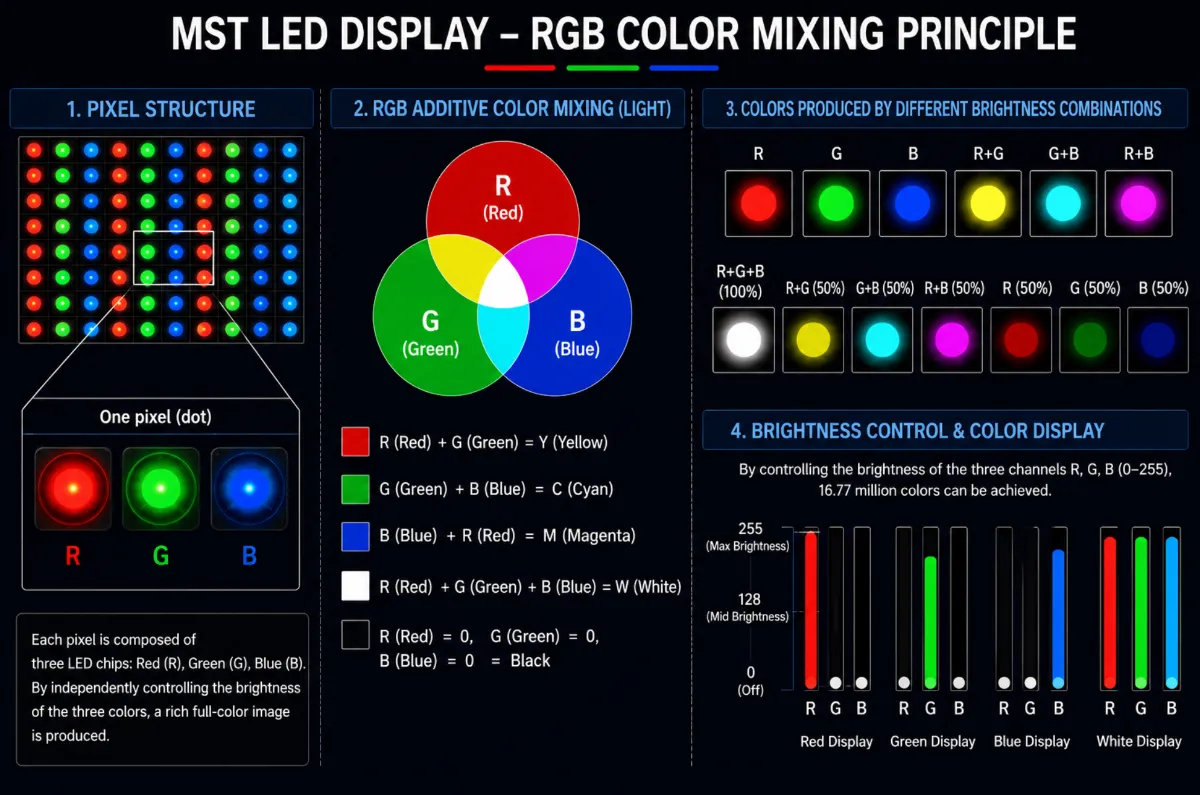
Ogni pixel LED emette diversi livelli di luce rossa, verde e blu per generare immagini a colori.
Principio di funzionamento di base
Il processo prevede generalmente:
- Ingresso segnale video
- Elaborazione del segnale
- Trasmissione dei dati
- Decodifica delle schede di ricezione
- Display a moduli LED
Miscelazione dei colori RGB
Ogni pixel contiene:
- LED rosso
- LED verde
- LED blu
Regolando i livelli di luminosità dei LED RGB, il display è in grado di riprodurre milioni di colori.
Processo di aggiornamento delle immagini
I display a LED aggiornano continuamente i fotogrammi delle immagini ad alta velocità.
Le frequenze di aggiornamento elevate offrono:
- Movimento fluido
- Immagini senza sfarfallio
- Better camera performance (higher LED screen refresh rate)
Frequenze di aggiornamento tipiche:
- 1920 Hz
- 3840 Hz
- 7680 Hz
Trasmissione del segnale
Il percorso del segnale:
Computer → Processore video → Scheda di trasmissione → Scheda di ricezione → Modulo LED
Sistemi sincroni e asincroni
Sistema di sincronizzazione
Trasmissione del segnale in tempo reale.
Utilizzato per:
- Eventi dal vivo
- Palchi XR
- Trasmissione
Sistema asincrono
Contenuti memorizzati localmente.
Utilizzato per:
- Schermi pubblicitari
- Segnaletica digitale
Example: How a Stage LED Screen Is Controlled
A typical 6 × 3.5 m rental LED screen for a concert shows how the system works in practice:
- Source: a media server or laptop outputs a 1920×1080, 60 Hz video signal via HDMI or SDI.
- Video processor: scales the image to the LED screen resolution (for example 2304×1344 at P2.6) and adjusts brightness and color.
- Sending card: converts the video into LED data and sends it over Cat6 or fiber, each port driving up to about 650,000 pixels.
- Receiving cards: one per cabinet, each takes its share of the image and passes it to the LED modules.
- Driver ICs: on each module switch the red, green and blue LEDs at a refresh rate of 3,840 Hz or higher so the screen looks flicker-free on camera.
Because data is transmitted in a daisy chain with backup loops, a single cable failure will not black out the LED display.
DDW Technical Insight: How LED Display Screens Work
I display a LED combinano elettronica avanzata, elaborazione delle immagini e sistemi di controllo digitale per offrire immagini di grandi dimensioni senza interruzioni in innumerevoli applicazioni professionali.
FAQ
How does an LED screen display colors?
Each pixel mixes red, green and blue LEDs at different brightness levels. Combining them produces millions (or billions) of colors.
What is the difference between synchronous and asynchronous LED displays?
A synchronous LED display shows content in real time from a computer; an asynchronous one stores content on a player card and plays it independently.
What controls an LED display?
A control system of sending card (or video processor), receiving cards and software such as NovaStar or Colorlight drives the LED display screen.
Related LED Display Guides
- What is an LED display
- LED display screen structure
- LED screen refresh rate
- SMD vs DIP LED screen
- LED display pixel pitch explained
Recommended DDW products: HK Series HD indoor LED screen · Schermo LED a noleggio della serie A