
Quick answer: An LED display screen works by grouping red, green and blue LEDs into pixels. A sending card converts the video signal into data, receiving cards distribute it to LED modules, and driver ICs switch each LED on and off thousands of times per second (PWM) to create the image and colors.
Основное понимание
Светодиодные дисплеи работают за счет управления миллионами крошечных светодиодов, что позволяет создавать динамические изображения и видео в режиме реального времени.
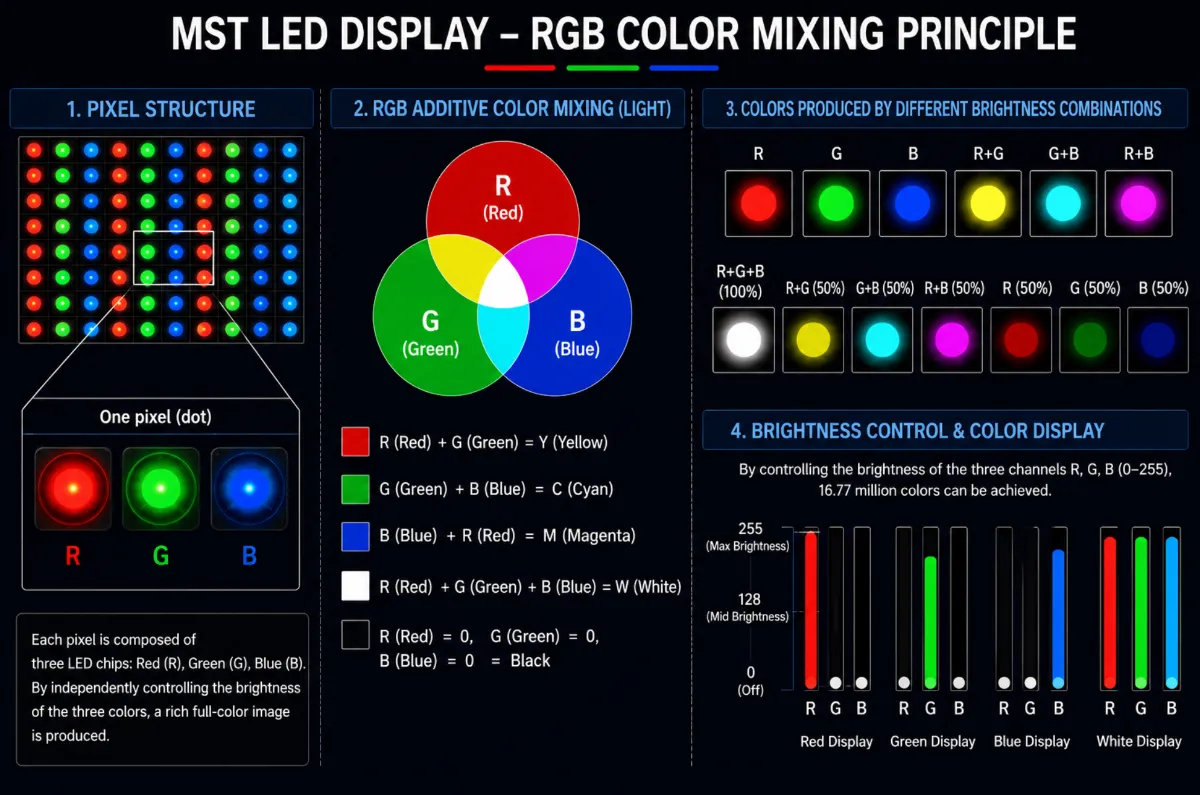
Каждый светодиодный пиксель излучает красный, зеленый и синий свет различной интенсивности, что позволяет создавать полноцветные изображения.
Основной принцип работы
Как правило, этот процесс включает в себя:
- Вход видеосигнала
- Обработка сигналов
- Передача данных
- Декодирование принимаемой карты
- Светодиодный модульный дисплей
Смешивание цветов в системе RGB
Каждый пиксель содержит:
- Красный светодиод
- Зелёный светодиод
- Синий светодиод
Благодаря регулировке уровня яркости светодиодов RGB дисплей способен воспроизводить миллионы цветов.
Процесс обновления изображения
Светодиодные дисплеи непрерывно обновляют кадры изображения с высокой скоростью.
Высокая частота обновления обеспечивает:
- Плавное движение
- Изображение без мерцания
- Better camera performance (higher LED screen refresh rate)
Типичные частоты обновления:
- 1920 Гц
- 3840 Гц
- 7680 Гц
Передача сигнала
Тракт сигнала:
Компьютер → Видеопроцессор → Передающая плата → Приемная плата → Светодиодный модуль
Синхронные и асинхронные системы
Система синхронизации
Передача сигналов в режиме реального времени.
Используется для:
- Мероприятия в режиме реального времени
- XR-сцены
- Трансляция
Асинхронная система
Контент, хранящийся локально.
Используется для:
- Рекламные экраны
- Цифровые вывески
Example: How a Stage LED Screen Is Controlled
A typical 6 × 3.5 m rental LED screen for a concert shows how the system works in practice:
- Source: a media server or laptop outputs a 1920×1080, 60 Hz video signal via HDMI or SDI.
- Video processor: scales the image to the LED screen resolution (for example 2304×1344 at P2.6) and adjusts brightness and color.
- Sending card: converts the video into LED data and sends it over Cat6 or fiber, each port driving up to about 650,000 pixels.
- Receiving cards: one per cabinet, each takes its share of the image and passes it to the LED modules.
- Driver ICs: on each module switch the red, green and blue LEDs at a refresh rate of 3,840 Hz or higher so the screen looks flicker-free on camera.
Because data is transmitted in a daisy chain with backup loops, a single cable failure will not black out the LED display.
DDW Technical Insight: How LED Display Screens Work
Светодиодные экраны сочетают в себе передовую электронику, технологии обработки изображений и цифровые системы управления, что позволяет создавать плавные крупноформатные визуальные эффекты в бесчисленных профессиональных сферах применения.
FAQ
How does an LED screen display colors?
Each pixel mixes red, green and blue LEDs at different brightness levels. Combining them produces millions (or billions) of colors.
What is the difference between synchronous and asynchronous LED displays?
A synchronous LED display shows content in real time from a computer; an asynchronous one stores content on a player card and plays it independently.
What controls an LED display?
A control system of sending card (or video processor), receiving cards and software such as NovaStar or Colorlight drives the LED display screen.
Related LED Display Guides
- What is an LED display
- LED display screen structure
- LED screen refresh rate
- SMD vs DIP LED screen
- LED display pixel pitch explained
Recommended DDW products: HK Series HD indoor LED screen · Светодиодный экран серии A для аренды