
Quick answer: An LED display screen works by grouping red, green and blue LEDs into pixels. A sending card converts the video signal into data, receiving cards distribute it to LED modules, and driver ICs switch each LED on and off thousands of times per second (PWM) to create the image and colors.
Hiểu biết cốt lõi
LED displays operate by controlling millions of tiny LEDs to create dynamic images and videos in real time.
Each LED pixel emits different levels of red, green, and blue light to generate full-color visuals.
Basic Working Principle
The process generally includes:
- Video signal input
- Signal processing
- Data transmission
- Receiving card decoding
- LED module display
RGB Color Mixing
Each pixel contains:
- Red LED
- Green LED
- Blue LED
By adjusting brightness levels of RGB LEDs, the display can reproduce millions of colors.
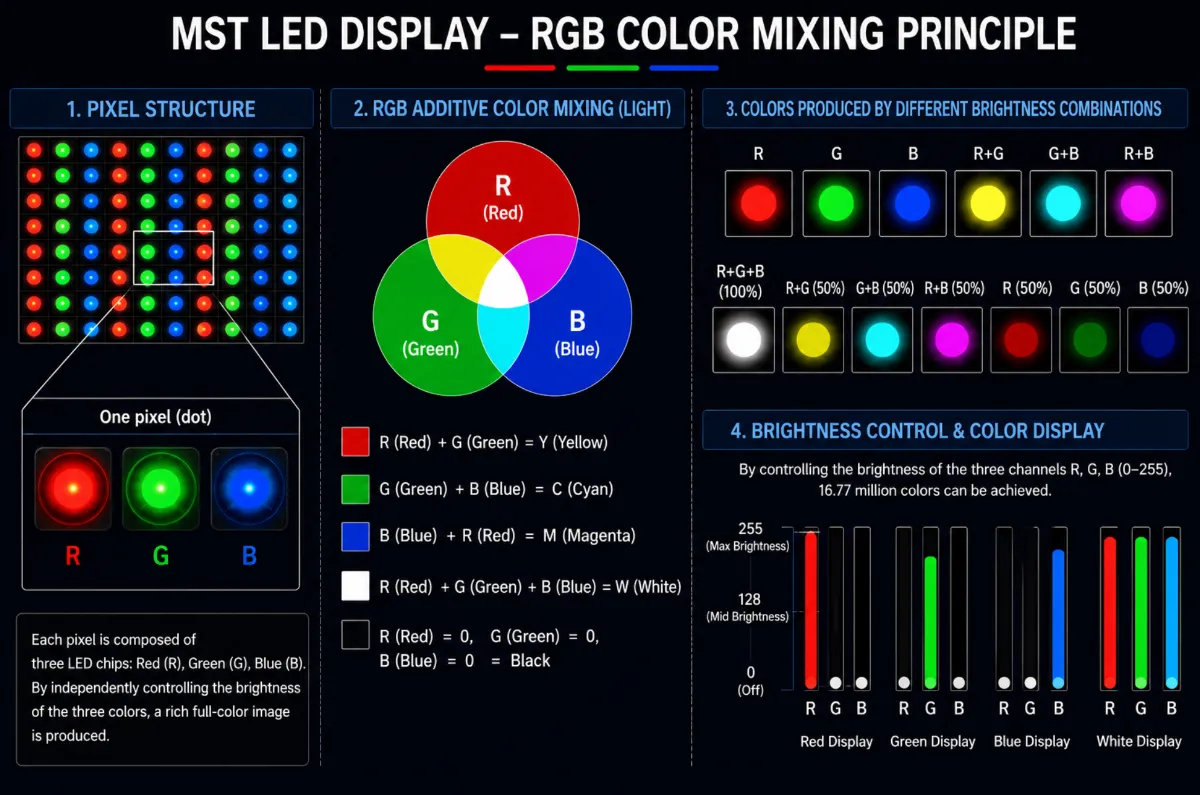
Image Refresh Process
LED displays continuously refresh image frames at high speed.
High refresh rates provide:
- Smooth motion
- Flicker-free visuals
- Better camera performance (higher LED screen refresh rate)
Typical refresh rates:
- 1920 Hz
- 3840 Hz
- 7680 Hz
Signal Transmission
The signal path:
Computer → Video Processor → Sending Card → Receiving Card → LED Module
Synchronizing vs Asynchronous Systems
Synchronizing System
Real-time signal transmission.
Used for:
- Live events
- Các sân khấu XR
- Phát sóng
Asynchronous System
Content stored locally.
Used for:
- Advertising screens
- Digital signage
Example: How a Stage LED Screen Is Controlled
A typical 6 × 3.5 m rental LED screen for a concert shows how the system works in practice:
- Source: a media server or laptop outputs a 1920×1080, 60 Hz video signal via HDMI or SDI.
- Video processor: scales the image to the LED screen resolution (for example 2304×1344 at P2.6) and adjusts brightness and color.
- Sending card: converts the video into LED data and sends it over Cat6 or fiber, each port driving up to about 650,000 pixels.
- Receiving cards: one per cabinet, each takes its share of the image and passes it to the LED modules.
- Driver ICs: on each module switch the red, green and blue LEDs at a refresh rate of 3,840 Hz or higher so the screen looks flicker-free on camera.
Because data is transmitted in a daisy chain with backup loops, a single cable failure will not black out the LED display.
DDW Technical Insight: How LED Display Screens Work
LED displays combine advanced electronics, image processing, and digital control systems to deliver seamless large-scale visuals across countless professional applications.
FAQ
How does an LED screen display colors?
Each pixel mixes red, green and blue LEDs at different brightness levels. Combining them produces millions (or billions) of colors.
What is the difference between synchronous and asynchronous LED displays?
A synchronous LED display shows content in real time from a computer; an asynchronous one stores content on a player card and plays it independently.
What controls an LED display?
A control system of sending card (or video processor), receiving cards and software such as NovaStar or Colorlight drives the LED display screen.
Related LED Display Guides
- What is an LED display
- LED display screen structure
- LED screen refresh rate
- SMD vs DIP LED screen
- LED display pixel pitch explained
Recommended DDW products: HK Series HD indoor LED screen · Màn hình LED cho thuê dòng A