
Quick answer: An LED display screen works by grouping red, green and blue LEDs into pixels. A sending card converts the video signal into data, receiving cards distribute it to LED modules, and driver ICs switch each LED on and off thousands of times per second (PWM) to create the image and colors.
الفهم الأساسي
تعمل شاشات LED من خلال التحكم في ملايين مصابيح LED الصغيرة لإنشاء صور ومقاطع فيديو ديناميكية في الوقت الفعلي.
يصدر كل بكسل من مصابيح LED مستويات مختلفة من الضوء الأحمر والأخضر والأزرق لتوليد صور ملونة بالكامل.
مبدأ العمل الأساسي
وتشمل العملية عمومًا ما يلي:
- مدخل إشارة الفيديو
- معالجة الإشارات
- نقل البيانات
- فك تشفير بطاقة الاستلام
- شاشة وحدة LED
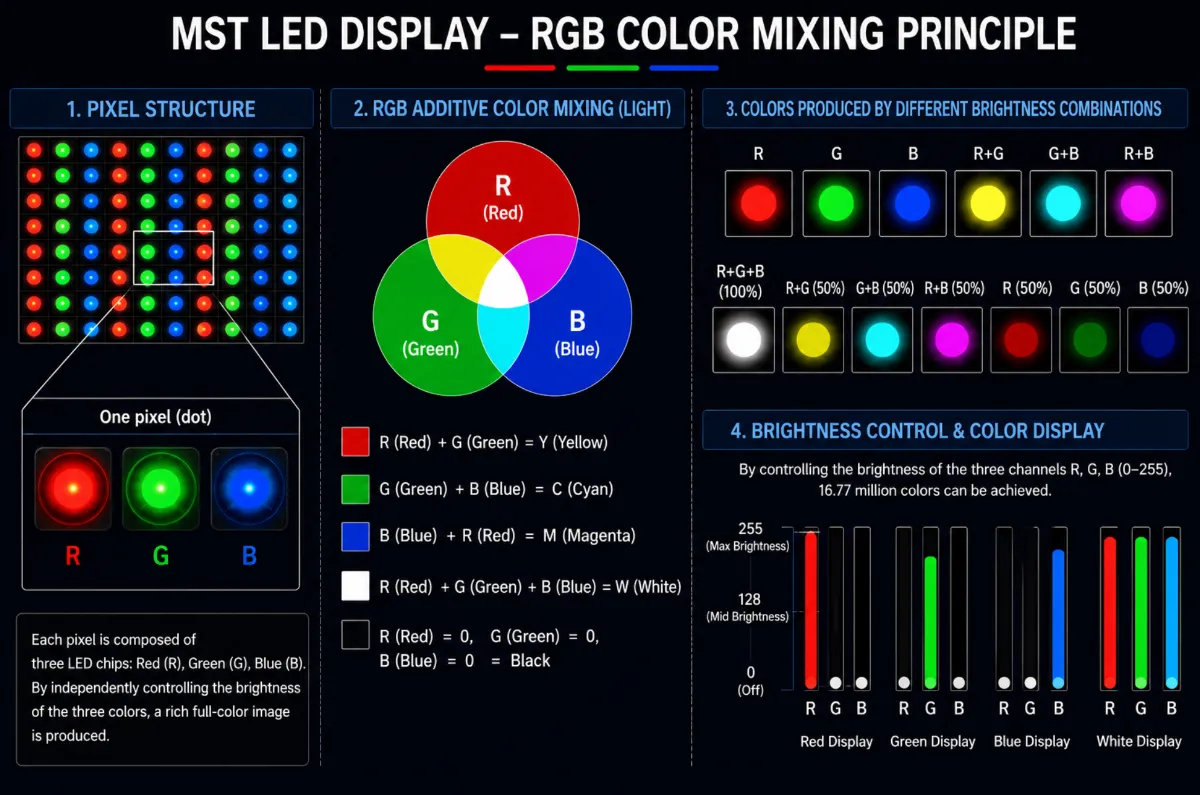
مزج ألوان RGB
يحتوي كل بكسل على:
- مصباح LED أحمر
- مصباح LED أخضر
- مصباح LED أزرق
من خلال ضبط مستويات سطوع مصابيح LED التي تعمل بتقنية RGB، يمكن للشاشة عرض ملايين الألوان.
عملية تحديث الصورة
تقوم شاشات LED بتحديث إطارات الصورة باستمرار بسرعة عالية.
توفر معدلات التحديث العالية ما يلي:
- حركة سلسة
- صور خالية من الوميض
- Better camera performance (higher LED screen refresh rate)
معدلات التحديث النموذجية:
- 1920 هرتز
- 3840 هرتز
- 7680 هرتز
نقل الإشارات
مسار الإشارة:
الكمبيوتر → معالج الفيديو → بطاقة الإرسال → بطاقة الاستقبال → وحدة LED
الأنظمة المتزامنة مقابل الأنظمة غير المتزامنة
نظام المزامنة
نقل الإشارات في الوقت الفعلي.
تُستخدم في:
- الفعاليات الحية
- مراحل XR
- البث
نظام غير متزامن
المحتوى المخزن محليًّا.
تُستخدم في:
- شاشات إعلانية
- اللافتات الرقمية
Example: How a Stage LED Screen Is Controlled
A typical 6 × 3.5 m rental LED screen for a concert shows how the system works in practice:
- Source: a media server or laptop outputs a 1920×1080, 60 Hz video signal via HDMI or SDI.
- Video processor: scales the image to the LED screen resolution (for example 2304×1344 at P2.6) and adjusts brightness and color.
- Sending card: converts the video into LED data and sends it over Cat6 or fiber, each port driving up to about 650,000 pixels.
- Receiving cards: one per cabinet, each takes its share of the image and passes it to the LED modules.
- Driver ICs: on each module switch the red, green and blue LEDs at a refresh rate of 3,840 Hz or higher so the screen looks flicker-free on camera.
Because data is transmitted in a daisy chain with backup loops, a single cable failure will not black out the LED display.
DDW Technical Insight: How LED Display Screens Work
تجمع شاشات LED بين الإلكترونيات المتطورة ومعالجة الصور وأنظمة التحكم الرقمية لتقديم صور سلسة وواسعة النطاق عبر عدد لا يحصى من التطبيقات الاحترافية.
FAQ
How does an LED screen display colors?
Each pixel mixes red, green and blue LEDs at different brightness levels. Combining them produces millions (or billions) of colors.
What is the difference between synchronous and asynchronous LED displays?
A synchronous LED display shows content in real time from a computer; an asynchronous one stores content on a player card and plays it independently.
What controls an LED display?
A control system of sending card (or video processor), receiving cards and software such as NovaStar or Colorlight drives the LED display screen.
Related LED Display Guides
- What is an LED display
- LED display screen structure
- LED screen refresh rate
- SMD vs DIP LED screen
- LED display pixel pitch explained
Recommended DDW products: HK Series HD indoor LED screen · شاشة LED من سلسلة A متاحة للتأجير