
Quick answer: An LED display screen works by grouping red, green and blue LEDs into pixels. A sending card converts the video signal into data, receiving cards distribute it to LED modules, and driver ICs switch each LED on and off thousands of times per second (PWM) to create the image and colors.
Grundlegendes Verständnis
LED-Displays funktionieren so, dass Millionen winziger LEDs gesteuert werden, um dynamische Bilder und Videos in Echtzeit zu erzeugen.
Jedes LED-Pixel strahlt unterschiedliche Intensitäten von rotem, grünem und blauem Licht aus, um Vollfarbbilder zu erzeugen.
Grundlegendes Funktionsprinzip
Der Prozess umfasst im Allgemeinen:
- Videosignaleingang
- Signalverarbeitung
- Datenübertragung
- Empfangskarten-Decodierung
- LED-Modul-Anzeige
RGB-Farbmischung
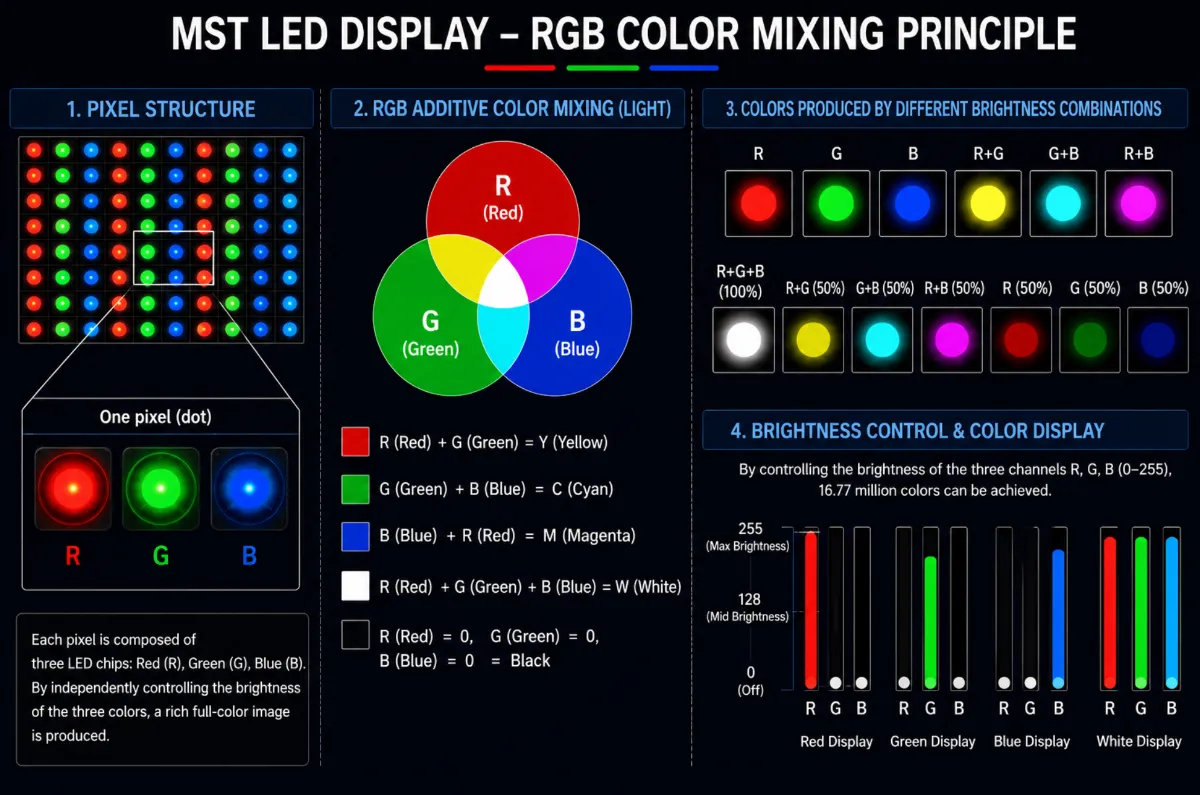
Jedes Pixel enthält:
- Rote LED
- Grüne LED
- Blaue LED
Durch die Anpassung der Helligkeitsstufen der RGB-LEDs kann das Display Millionen von Farben darstellen.
Bildaktualisierungsprozess
LED-Displays aktualisieren Bildrahmen kontinuierlich mit hoher Geschwindigkeit.
Hohe Bildwiederholraten bieten:
- Flüssige Bewegung
- Flimmerfreie Bilder
- Better camera performance (higher LED screen refresh rate)
Typische Bildwiederholraten:
- 1920 Hz
- 3840 Hz
- 7680 Hz
Signalübertragung
Der Signalweg:
Computer → Videoprozessor → Sendekarte → Empfangskarte → LED-Modul
Synchrone vs. asynchrone Systeme
Synchronisationssystem
Signalübertragung in Echtzeit.
Verwendungszweck:
- Live-Veranstaltungen
- XR-Bühnen
- Sendung
Asynchrones System
Lokal gespeicherte Inhalte.
Verwendungszweck:
- Werbeanzeigen
- Digital Signage
Example: How a Stage LED Screen Is Controlled
A typical 6 × 3.5 m rental LED screen for a concert shows how the system works in practice:
- Source: a media server or laptop outputs a 1920×1080, 60 Hz video signal via HDMI or SDI.
- Video processor: scales the image to the LED screen resolution (for example 2304×1344 at P2.6) and adjusts brightness and color.
- Sending card: converts the video into LED data and sends it over Cat6 or fiber, each port driving up to about 650,000 pixels.
- Receiving cards: one per cabinet, each takes its share of the image and passes it to the LED modules.
- Driver ICs: on each module switch the red, green and blue LEDs at a refresh rate of 3,840 Hz or higher so the screen looks flicker-free on camera.
Because data is transmitted in a daisy chain with backup loops, a single cable failure will not black out the LED display.
DDW Technical Insight: How LED Display Screens Work
LED-Displays vereinen modernste Elektronik, Bildverarbeitung und digitale Steuerungssysteme, um nahtlose großflächige Bilddarstellungen für unzählige professionelle Anwendungsbereiche zu ermöglichen.
FAQ
How does an LED screen display colors?
Each pixel mixes red, green and blue LEDs at different brightness levels. Combining them produces millions (or billions) of colors.
What is the difference between synchronous and asynchronous LED displays?
A synchronous LED display shows content in real time from a computer; an asynchronous one stores content on a player card and plays it independently.
What controls an LED display?
A control system of sending card (or video processor), receiving cards and software such as NovaStar or Colorlight drives the LED display screen.
Related LED Display Guides
- What is an LED display
- LED display screen structure
- LED screen refresh rate
- SMD vs DIP LED screen
- LED display pixel pitch explained
Recommended DDW products: HK Series HD indoor LED screen · LED-Anzeige der A-Serie zur Miete