
Quick answer: An LED display screen works by grouping red, green and blue LEDs into pixels. A sending card converts the video signal into data, receiving cards distribute it to LED modules, and driver ICs switch each LED on and off thousands of times per second (PWM) to create the image and colors.
मूल समझ
एलईडी डिस्प्ले लाखों छोटे-छोटे एलईडी को नियंत्रित करके वास्तविक समय में गतिशील छवियाँ और वीडियो बनाते हैं।.
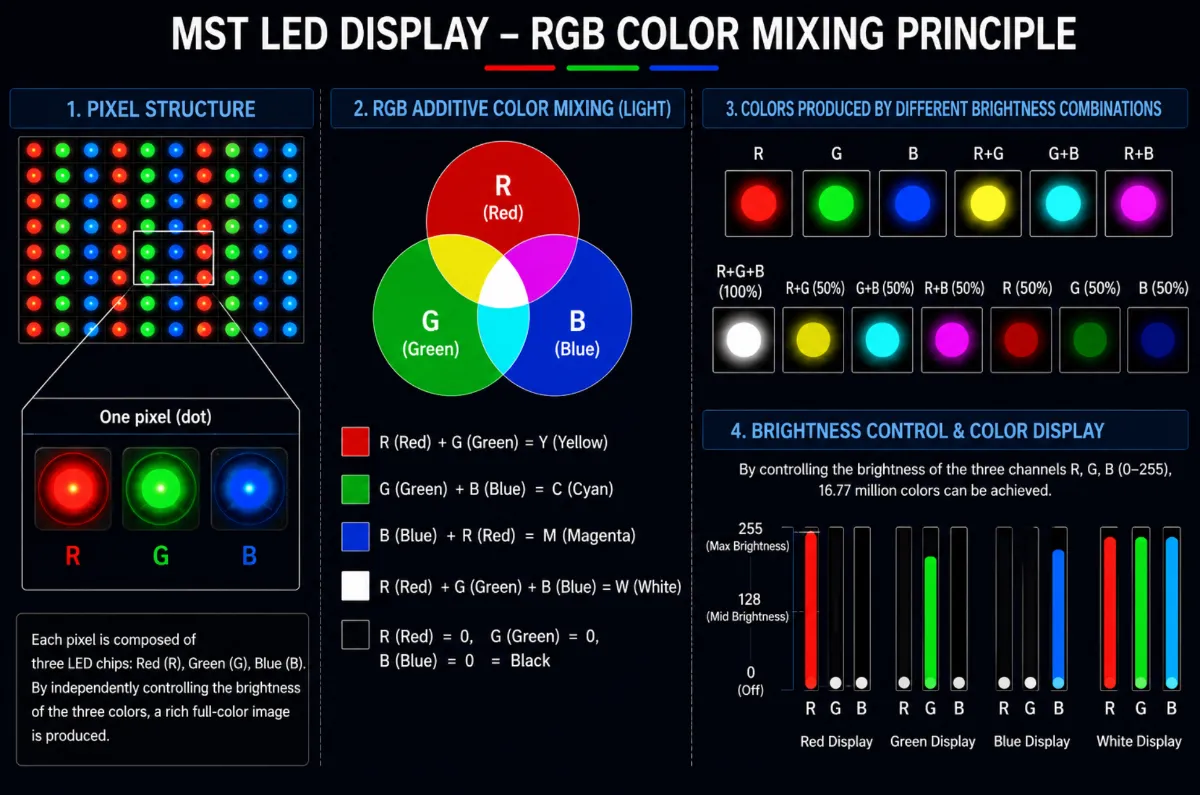
प्रत्येक LED पिक्सेल पूर्ण-रंगीन दृश्यों को उत्पन्न करने के लिए लाल, हरे और नीले प्रकाश के विभिन्न स्तर उत्सर्जित करता है।.
मूल कार्य सिद्धांत
प्रक्रिया में आम तौर पर शामिल हैं:
- वीडियो संकेत इनपुट
- संकेत प्रसंस्करण
- डेटा प्रसारण
- प्राप्त कार्ड डिकोडिंग
- एलईडी मॉड्यूल डिस्प्ले
आरजीबी रंग मिश्रण
प्रत्येक पिक्सेल में शामिल हैं:
- लाल एलईडी
- हरित एलईडी
- नीला एलईडी
RGB एलईडी की चमक स्तरों को समायोजित करके, डिस्प्ले लाखों रंगों को पुन: उत्पन्न कर सकता है।.
छवि ताज़ाकरण प्रक्रिया
एलईडी डिस्प्ले उच्च गति पर छवि फ्रेमों को लगातार ताज़ा करते हैं।.
उच्च रिफ्रेश दरें प्रदान करती हैं:
- समतल गति
- झिलमिलाहट-रहित दृश्य
- Better camera performance (higher LED screen refresh rate)
आम रिफ्रेश दरें:
- 1920 हर्ट्ज़
- 3840Hz
- ७६८० हर्ट्ज़
संकेत प्रसारण
संकेत पथ:
कंप्यूटर → वीडियो प्रोसेसर → भेजने वाला कार्ड → प्राप्त करने वाला कार्ड → एलईडी मॉड्यूल
समकालिक बनाम असमकालिक प्रणालियाँ
समकालिक प्रणाली
वास्तविक समय संकेत प्रसारण।.
उपयोग:
- लाइव इवेंट्स
- एक्सआर चरण
- प्रसारण
असिंक्रोनस प्रणाली
सामग्री स्थानीय रूप से संग्रहीत।.
उपयोग:
- विज्ञापन स्क्रीन
- डिजिटल साइनेज
Example: How a Stage LED Screen Is Controlled
A typical 6 × 3.5 m rental LED screen for a concert shows how the system works in practice:
- Source: a media server or laptop outputs a 1920×1080, 60 Hz video signal via HDMI or SDI.
- Video processor: scales the image to the LED screen resolution (for example 2304×1344 at P2.6) and adjusts brightness and color.
- Sending card: converts the video into LED data and sends it over Cat6 or fiber, each port driving up to about 650,000 pixels.
- Receiving cards: one per cabinet, each takes its share of the image and passes it to the LED modules.
- Driver ICs: on each module switch the red, green and blue LEDs at a refresh rate of 3,840 Hz or higher so the screen looks flicker-free on camera.
Because data is transmitted in a daisy chain with backup loops, a single cable failure will not black out the LED display.
DDW Technical Insight: How LED Display Screens Work
एलईडी डिस्प्ले उन्नत इलेक्ट्रॉनिक्स, छवि प्रसंस्करण और डिजिटल नियंत्रण प्रणालियों को संयोजित करते हैं, ताकि अनगिनत पेशेवर अनुप्रयोगों में निर्बाध बड़े पैमाने के दृश्य प्रदान किए जा सकें।.
FAQ
How does an LED screen display colors?
Each pixel mixes red, green and blue LEDs at different brightness levels. Combining them produces millions (or billions) of colors.
What is the difference between synchronous and asynchronous LED displays?
A synchronous LED display shows content in real time from a computer; an asynchronous one stores content on a player card and plays it independently.
What controls an LED display?
A control system of sending card (or video processor), receiving cards and software such as NovaStar or Colorlight drives the LED display screen.
Related LED Display Guides
- What is an LED display
- LED display screen structure
- LED screen refresh rate
- SMD vs DIP LED screen
- LED display pixel pitch explained
Recommended DDW products: HK Series HD indoor LED screen · एक श्रृंखला का किराए का एलईडी डिस्प्ले