
Quick answer: An LED display screen works by grouping red, green and blue LEDs into pixels. A sending card converts the video signal into data, receiving cards distribute it to LED modules, and driver ICs switch each LED on and off thousands of times per second (PWM) to create the image and colors.
核心的な理解
LEDディスプレイは、数百万個の微小なLEDを制御することで、リアルタイムにダイナミックな画像や動画を表示します。.
各LEDピクセルは、赤、緑、青の光をそれぞれ異なる強度で発光させ、フルカラーの映像を生成します。.
基本的な動作原理
このプロセスには、一般的に以下の内容が含まれます:
- 映像信号入力
- 信号処理
- データ伝送
- 受信カードの復号
- LEDモジュールディスプレイ
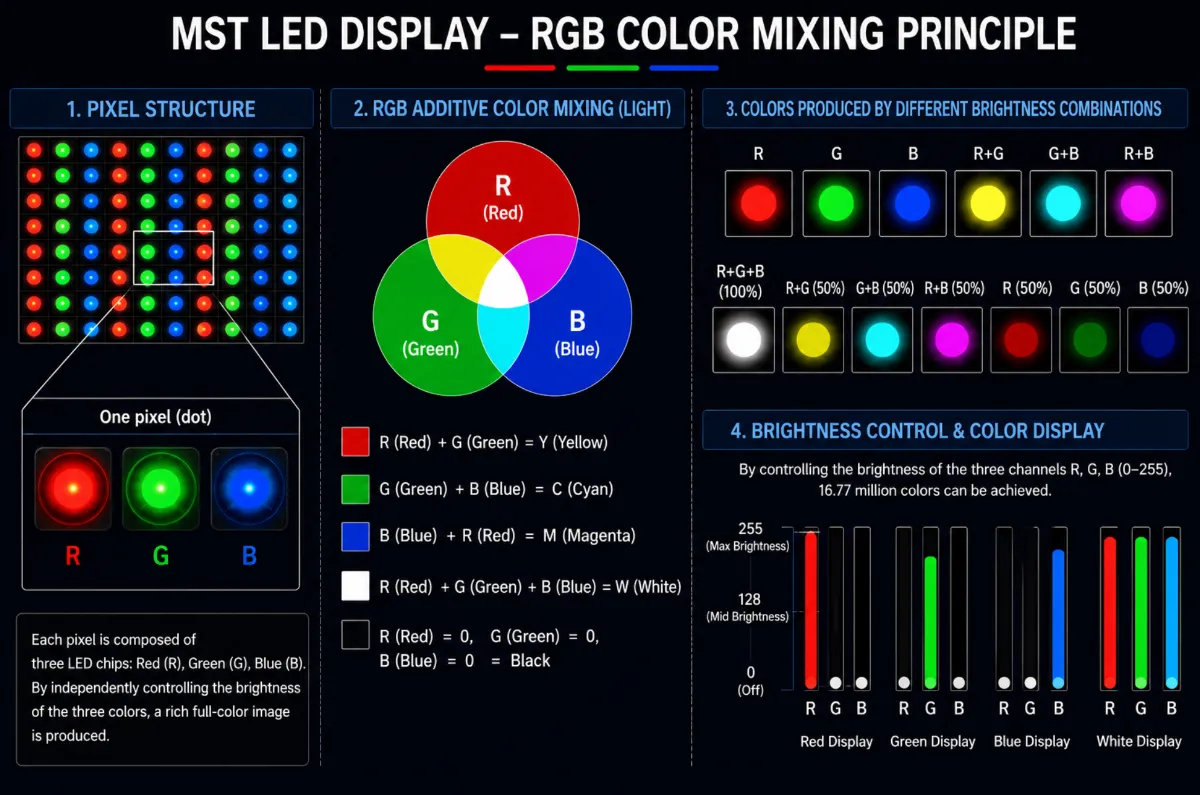
RGBの混色
各ピクセルには以下の情報が含まれています:
- 赤色LED
- 緑色のLED
- 青色LED
RGB LEDの輝度を調整することで、このディスプレイは数百万色もの色を再現することができます。.
画像の更新プロセス
LEDディスプレイは、画像フレームを高速で絶えず更新しています。.
高いリフレッシュレートには次のような利点があります:
- 滑らかな動き
- ちらつきのない映像
- Better camera performance (higher LED screen refresh rate)
一般的なリフレッシュレート:
- 1920Hz
- 3840Hz
- 7680Hz
信号伝送
信号経路:
コンピュータ → ビデオプロセッサ → 送信カード → 受信カード → LEDモジュール
同期システムと非同期システム
同期システム
リアルタイムの信号伝送。.
用途:
- ライブイベント
- XRステージ
- 放送
非同期システム
ローカルに保存されたコンテンツ。.
用途:
- 広告用スクリーン
- デジタルサイネージ
Example: How a Stage LED Screen Is Controlled
A typical 6 × 3.5 m rental LED screen for a concert shows how the system works in practice:
- Source: a media server or laptop outputs a 1920×1080, 60 Hz video signal via HDMI or SDI.
- Video processor: scales the image to the LED screen resolution (for example 2304×1344 at P2.6) and adjusts brightness and color.
- Sending card: converts the video into LED data and sends it over Cat6 or fiber, each port driving up to about 650,000 pixels.
- Receiving cards: one per cabinet, each takes its share of the image and passes it to the LED modules.
- Driver ICs: on each module switch the red, green and blue LEDs at a refresh rate of 3,840 Hz or higher so the screen looks flicker-free on camera.
Because data is transmitted in a daisy chain with backup loops, a single cable failure will not black out the LED display.
DDW Technical Insight: How LED Display Screens Work
LEDディスプレイは、最先端の電子技術、画像処理、およびデジタル制御システムを融合させ、数え切れないほどの業務用途において、途切れることのない大規模な映像を提供します。.
FAQ
How does an LED screen display colors?
Each pixel mixes red, green and blue LEDs at different brightness levels. Combining them produces millions (or billions) of colors.
What is the difference between synchronous and asynchronous LED displays?
A synchronous LED display shows content in real time from a computer; an asynchronous one stores content on a player card and plays it independently.
What controls an LED display?
A control system of sending card (or video processor), receiving cards and software such as NovaStar or Colorlight drives the LED display screen.
Related LED Display Guides
- What is an LED display
- LED display screen structure
- LED screen refresh rate
- SMD vs DIP LED screen
- LED display pixel pitch explained
Recommended DDW products: HK Series HD indoor LED screen · Aシリーズ レンタル用LEDディスプレイ