
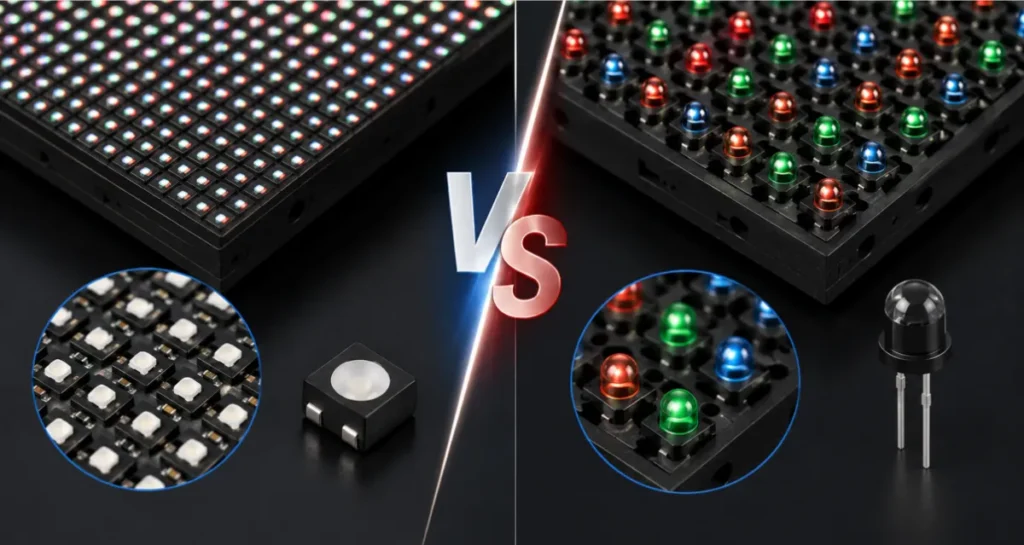
Quick answer: SMD (Surface-Mounted Device) packs red, green and blue chips into one LED, enabling fine pixel pitch, wide viewing angles and better color uniformity — the mainstream for indoor and most outdoor LED screens. DIP (Dual In-line Package) uses separate through-hole LEDs with very high brightness, now mainly used in large-pitch outdoor LED displays.
Core Understanding
SMD and DIP are two common LED packaging technologies used in LED displays.
Each technology offers different advantages depending on the application environment.
Why SMD Became the Mainstream LED Technology
SMD (Surface Mounted Device) integrates RGB chips into one compact package.
Advantages:
- Better color consistency
- Wider viewing angle
- Higher resolution
- Suitable for indoor fine-pitch displays
Common applications:
- Indoor LED displays
- Rental LED displays
- Conference rooms
- Retail environments
Why DIP Is Still Used in Outdoor Projects
DIP (Dual In-line Package) uses separate LED lamps mounted through the PCB.
Advantages:
- Higher brightness
- Better waterproof capability (higher LED screen IP rating)
- Strong outdoor durability
Common applications:
- Outdoor billboards
- Highway signs
- Stadium displays
Main Differences
| Feature | SMD | DIP |
| Viewing Angle | Wider | Narrower |
| Brightness | Medium | Higher |
| Resolution | Higher | Lower |
| Outdoor Resistance | Good | Excellent |
| Application | Indoor / Rental Outdoor | |
Which Technology Makes More Sense for Real Projects?
Choose SMD When:
- High image quality is required
- Close viewing distance
- Indoor applications
- XR or broadcast projects
Choose DIP When:
- Extreme outdoor brightness is needed
- Long-distance viewing
- Harsh outdoor environments

SMD vs DIP vs COB vs MIP
Beyond SMD and DIP, two newer LED packaging technologies now dominate fine-pitch LED display screens:
| Technology | Typical Pixel Pitch | Strengths | Best For |
|---|---|---|---|
| DIP | P10–P20+ | Very high brightness, rugged | Large outdoor billboards |
| SMD | P1.2–P10 | Balanced cost, color and viewing angle | Most indoor and outdoor LED screens |
| COB | P0.6–P1.9 | Sealed surface, impact and moisture resistant, deep black | Control rooms, meeting rooms, fine-pitch LED video walls |
| MIP | P0.4–P1.5 | Chip-level sorting for uniformity, repairable | Micro LED displays, broadcast, XR studios |
In short: SMD remains the most cost-effective choice above P1.5, while COB and MIP are the better options for LED displays below P1.2.
DDW Technical Insight: SMD vs DIP LED Screen
SMD dominates modern indoor and rental applications, while DIP still maintains advantages in high-brightness outdoor environments.
FAQ
Is SMD or DIP better for an LED display?
SMD is better for most LED displays because it offers finer pixel pitch, wider viewing angles and better image quality. DIP is only preferred for very bright, large-pitch outdoor screens.
Why is DIP brighter than SMD?
DIP LEDs use separate, focused red, green and blue lamps that deliver very high brightness, but with narrower viewing angles.
What comes after SMD in LED screen technology?
COB (Chip on Board) and MIP (Mini/Micro LED in Package) are used for fine-pitch LED displays below P1.2 for better protection and contrast.
Related LED Display Guides
- COB vs SMD vs GOB vs MIP comparison
- What is an LED display
- Indoor vs outdoor LED display
- LED screen IP rating
- LED display brightness (nits)
- LED display pixel pitch explained
- COB LED display technology
- MIP LED display technology
Recommended DDW products: FA Series outdoor LED screen · KCOB Series COB LED video wall