
Quick answer: Micro LED displays use microscopic LED chips for ultra-fine pitch, high brightness, deep blacks and long lifespan. Key trends are MIP and COB as main production routes, falling costs as yields improve, and adoption first in premium markets such as control rooms, broadcast, luxury retail and home cinema.
Micro LED Trends
Micro LED is becoming one of the most discussed technologies in the global display industry.
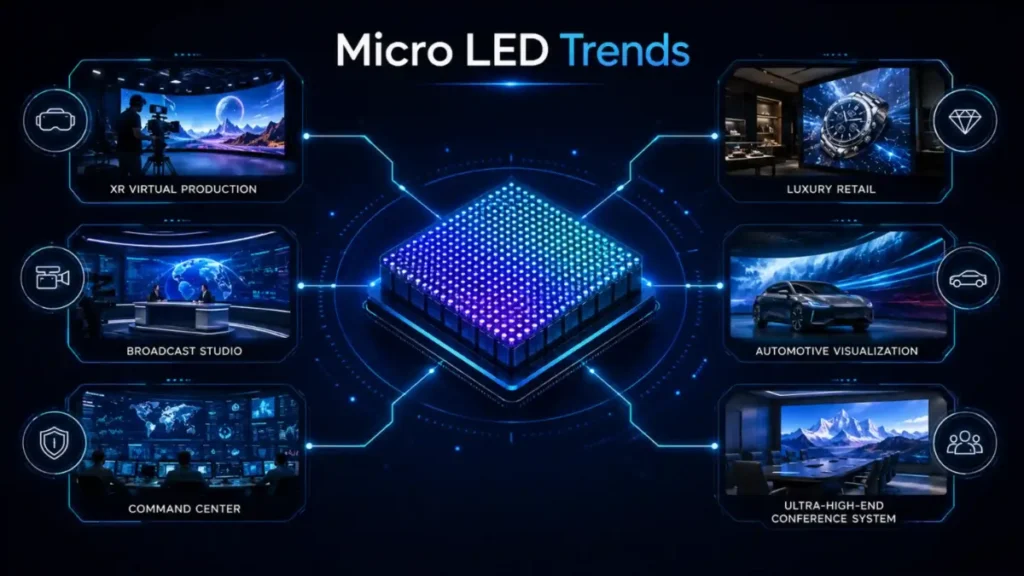
Many industry experts believe Micro LED may eventually redefine premium visual systems in:
- XR virtual production
- broadcast studios
- command centers
- luxury retail
- automotive visualization
- ultra-high-end conference systems
Why Micro LED Is Receiving So Much Attention
Traditional LED technologies continue improving rapidly, but ultra-fine-pitch applications now demand:
- higher pixel density
- lower power consumption
- better color consistency
- improved reliability
- finer visual structure
Micro LED aims to solve these challenges through:
- smaller chip structures
- advanced packaging
- higher integration precision
Why Fine-Pitch Demand Is Accelerating
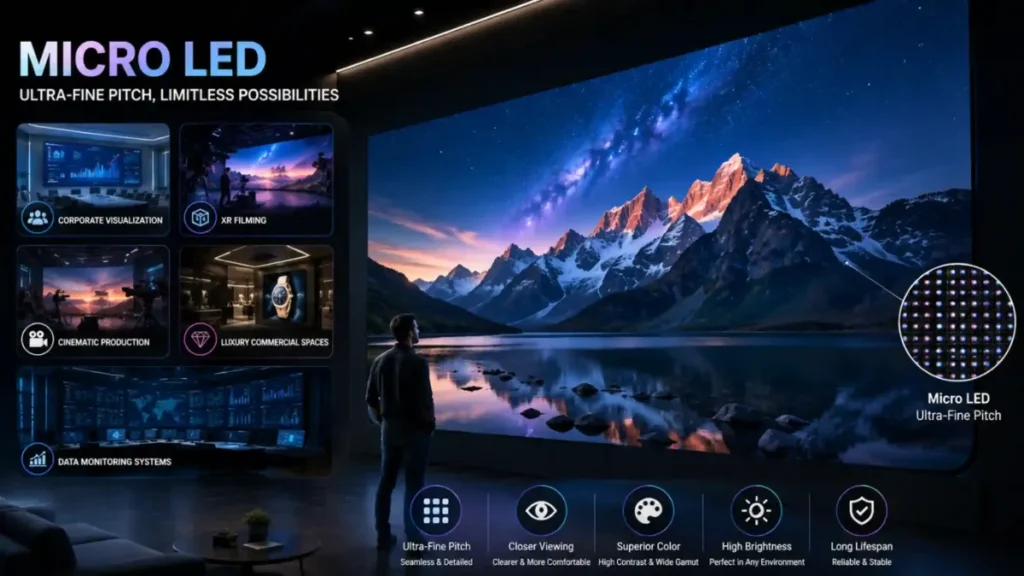
Global demand for ultra-fine pitch displays continues growing in:
- corporate visualization
- XR filming
- cinematic production
- luxury commercial spaces
- data monitoring systems
Viewers are standing closer to displays than ever before.
This pushes the industry toward:
- finer pitch
- smoother surfaces
- better calibration
- more immersive visuals
Why Production Complexity Remains a Challenge
Although Micro LED technology offers huge potential, manufacturing complexity remains one of the biggest barriers.
Challenges still include:
- mass transfer efficiency
- yield consistency
- calibration precision
- production cost
This is why large-scale commercialization still requires continuous technological improvement.
Why Premium Markets Will Adopt First
Micro LED adoption is currently growing fastest in premium sectors where customers prioritize:
- image quality
- long-term reliability
- visual precision
- advanced branding experience
This is especially visible in:
- luxury retail flagship stores
- automotive showrooms
- XR virtual production
- high-end command centers
DDW Engineer Notes: Micro LED display trends
Many customers expect Micro LED to immediately replace all existing LED technologies.
In reality, the market transition will likely happen gradually.
For many current commercial projects, mature technologies such as COB and advanced SMD still provide excellent balance between:
- performance
- reliability
- cost efficiency
- scalability
Micro LED represents the future direction of the industry, but engineering practicality still remains extremely important.
Micro LED Trends at a Glance
| Trend | What Is Changing | What It Means for Buyers |
|---|---|---|
| Manufacturing routes | MIP and COB mature | More stable supply of fine-pitch products |
| Cost reduction | Better yields and mass transfer | Micro LED reaches more projects over time |
| Finer pitch | P0.9 and below | Seamless 4K/8K walls in smaller rooms |
| Premium first | Control rooms, broadcast, luxury | Early adopters value image and reliability |
| Consumer interest | Large home and corporate screens | Growing awareness of Micro LED benefits |
FAQ
What is the difference between Micro LED and Mini LED?
Micro LED uses self-emissive microscopic LEDs as pixels; Mini LED usually refers to LED backlights for LCD or larger LED chips.
Is MIP a Micro LED technology?
MIP (Micro LED in Package) is one of the main ways to produce Micro LED displays with chip sorting and easy repair.
When will Micro LED become affordable?
Costs are falling as manufacturing yields improve, with premium applications adopting it first.
Related LED Display Guides
- MIP LED display technology
- COB LED display technology
- COB vs SMD vs GOB vs MIP comparison
- Fine pitch LED display guide
- The future of LED displays
Recommended DDW products: ORBIT MIP Series fine pitch LED display · QDCOB Series COB LED display