
Quick answer: To buy an LED display: define the application, measure viewing distance, choose pixel pitch, set brightness and protection for the environment, size the screen, plan installation and power, select the control system, set a total budget, verify the supplier and confirm warranty and spare parts.
For many first-time buyers, choosing an LED display can feel confusing because there are too many specifications:
- pixel pitch
- brightness
- refresh rate
- cabinet size
- waterproof rating
- control systems
- installation methods
However, experienced LED engineers rarely begin with specifications alone.
The first question is usually:
“What is the actual application environment?”
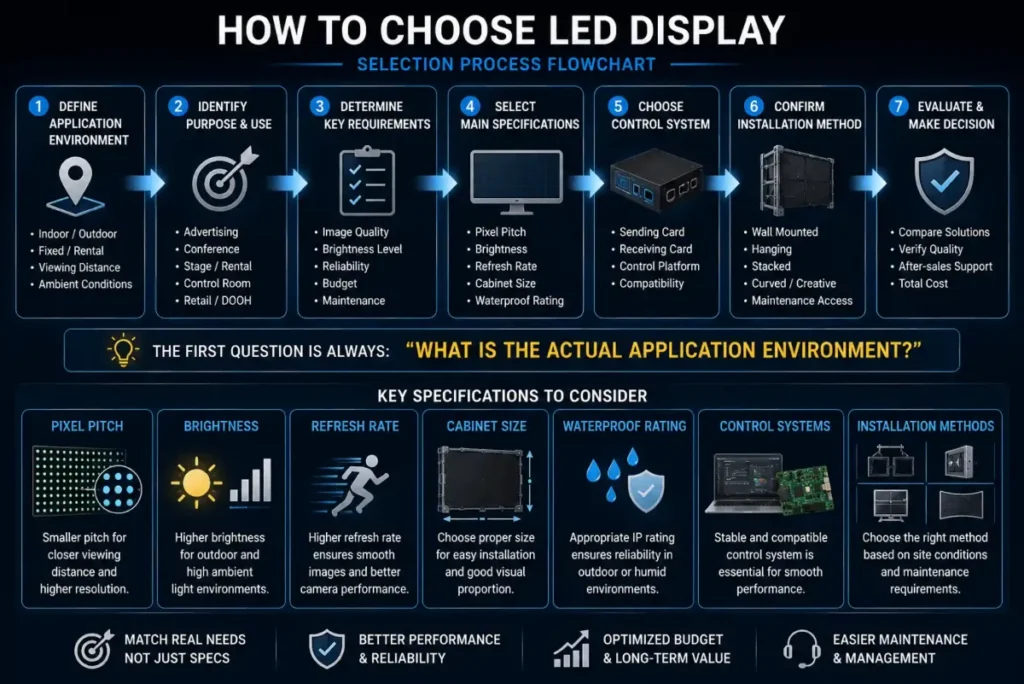
Why Application Matters More Than Specifications
The same LED product may perform completely differently in different environments.
For example:
Application | Main Priority |
XR Studio | Camera performance |
Church | Viewing comfort |
Outdoor Billboard | Brightness & reliability |
Retail Store | Premium appearance |
Conference Room | Text readability |
Stadium | Long-distance visibility |
Exhibition Booth | Fast installation |
This is why professional LED selection always starts from the real project scenario.
The 5 Most Important Factors
- Viewing Distance
Closer viewing usually requires finer pixel pitch.
- Indoor or Outdoor
Outdoor systems prioritize:
- waterproofing
- brightness
- heat resistance
Indoor systems prioritize:
- image smoothness
- close-viewing comfort
- elegant appearance
- Installation Method
Different installation methods require different cabinet structures:
- wall mounted
- hanging
- curved
- floor support
- transparent facade
- Content Type
Text-heavy applications usually need finer pitch.
Video-heavy projects may allow larger pitch.
- Long-Term Maintenance
Many buyers underestimate future maintenance requirements.
Easy maintenance access often becomes critical after years of operation.
DDW Engineer Notes: LED display buying guide
Many customers initially compare only specifications and pricing.
However, experienced system integrators usually evaluate:
- environment
- audience behavior
- maintenance conditions
- operating hours
- future scalability
The best LED display is not always the highest specification.
It is the system that best fits the real project.
10-Step LED Display Buying Checklist
- Define the application and content.
- Measure the closest and farthest viewing distance.
- Choose pixel pitch from the viewing distance.
- Set brightness and IP rating for the environment.
- Decide screen size and aspect ratio.
- Plan installation method, structure and power.
- Select the control system and video sources.
- Set a total budget including installation and spares.
- Verify the supplier’s quality and references.
- Confirm warranty, spare parts and support terms.
FAQ
What is the first step in buying an LED display?
Define the application and measure viewing distance; these determine pixel pitch, brightness and size.
How much budget should I reserve beyond the screen?
Reserve for structure, installation, power, control, shipping and spare parts, which can add a significant share to the screen price.
What documents should I get from the supplier?
Specifications, drawings, test and calibration reports, certificates, warranty terms and a spare parts list.
Related LED Display Guides
- LED display price per square meter
- How to choose an LED display by application
- LED display pixel pitch chart
- LED display price factors
- How to choose an LED display supplier
- LED display warranty guide
Recommended DDW products: KCOB Series COB LED video wall · FA Series outdoor LED screen