
Quick answer: LED display modules are powered by switching power supplies that convert AC mains to low-voltage DC, typically around 4.2–5 V (or split voltages for common cathode designs). Choose high-efficiency units with active power factor correction, 20–30% load margin, full protection (over-voltage, over-current, short circuit, over-temperature) and relevant safety certificates.
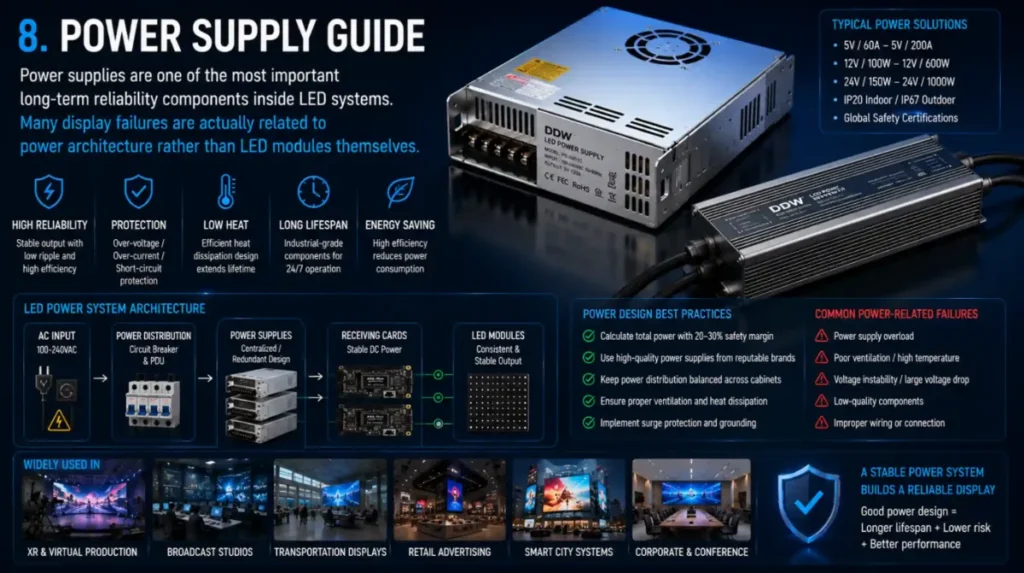
Power Supply Guide
Power supplies are one of the most important long-term reliability components inside LED systems.
Many display failures are actually related to power architecture rather than LED modules themselves.
Why Power Quality Affects
Everything
Unstable power may gradually create:
- brightness fluctuation
- parpadeante
- signal instability
- sobrecalentamiento
- shortened component lifespan
Esto se vuelve especialmente crítico en:
- publicidad exterior
- sistemas para estadios
- Producción de XR
- entornos de trabajo con horarios prolongados
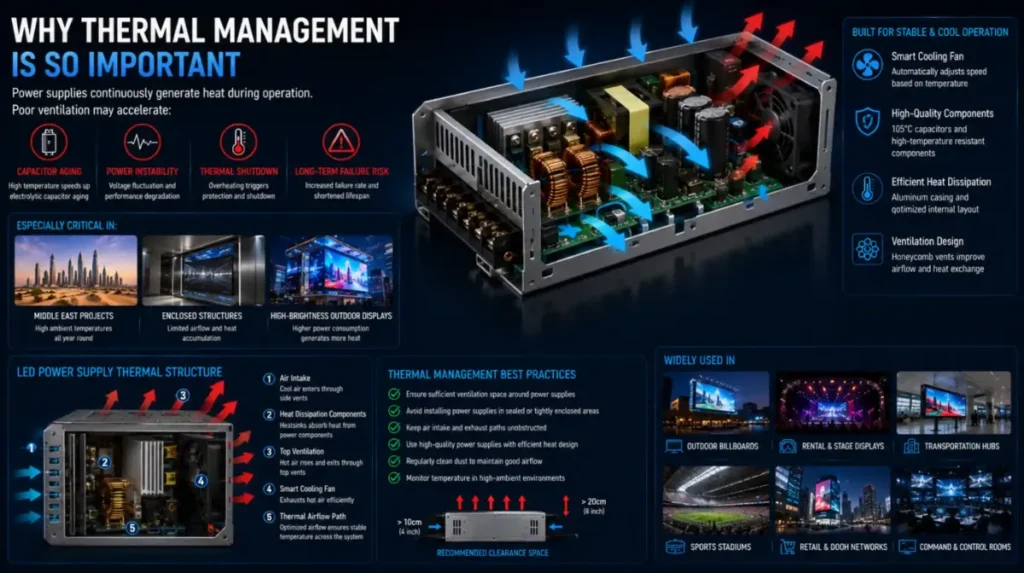
Why Thermal Management Is So Important
Power supplies continuously generate heat during operation.
Poor ventilation may accelerate:
- capacitor aging
- power instability
- thermal shutdown
- long-term failure risk
Esto se vuelve especialmente crítico en:
- Proyectos en Oriente Medio
- estructuras cerradas
- pantallas para exteriores de alto brillo
Why Common Cathode Systems Improve Efficiency
Modern energy-saving LED systems increasingly use:
- common cathode arquitectura
- intelligent power distribution
- dynamic brightness adjustment
This helps reduce:
- power consumption
- generación de calor
- coste de explotación
DDW Engineer Notes: LED display power supply
Many customers focus heavily on waterproofing while ignoring airflow design.
In reality, poor thermal management often creates much greater long-term risk than rain exposure itself.
Stable power architecture is one of the foundations of reliable LED engineering.
How to Choose an LED Power Supply
| Specification | What to Look For |
|---|---|
| Output voltage | About 4.2–5 V DC, or split rails for common cathode |
| Efficiency | High efficiency to reduce heat and energy use |
| Power factor | Active PFC for stable mains load |
| Load margin | Run at about 70–80% of rated power |
| Protection | OVP, OCP, short-circuit and over-temperature |
| Certification | CE, UL/ETL or other local safety marks |
FAQ
What voltage do LED display power supplies output?
Most output around 4.2–5 V DC; common cathode designs may use separate lower voltages for red and green/blue.
How many power supplies does an LED cabinet need?
It depends on module count and power; a typical cabinet uses one to several units sized with load margin.
Why do LED power supplies fail?
Heat, overload, unstable mains and aging capacitors are the most common causes.
Related LED Display Guides
- LED screen power supply failure
- LED screen power distribution guide
- Common cathode vs common anode LED
- LED display backup and redundancy
Recommended DDW products: FC Series energy-saving outdoor LED screen · FA Series outdoor LED screen