
Quick answer: An LED receiving card sits in each cabinet, receives video data from the sending card over network cable, and drives the LED modules in that cabinet. Key specs are pixel loading capacity, number of data groups, supported driver ICs, grayscale and refresh performance, calibration data storage and monitoring or redundancy features.
Tarjeta de recepción
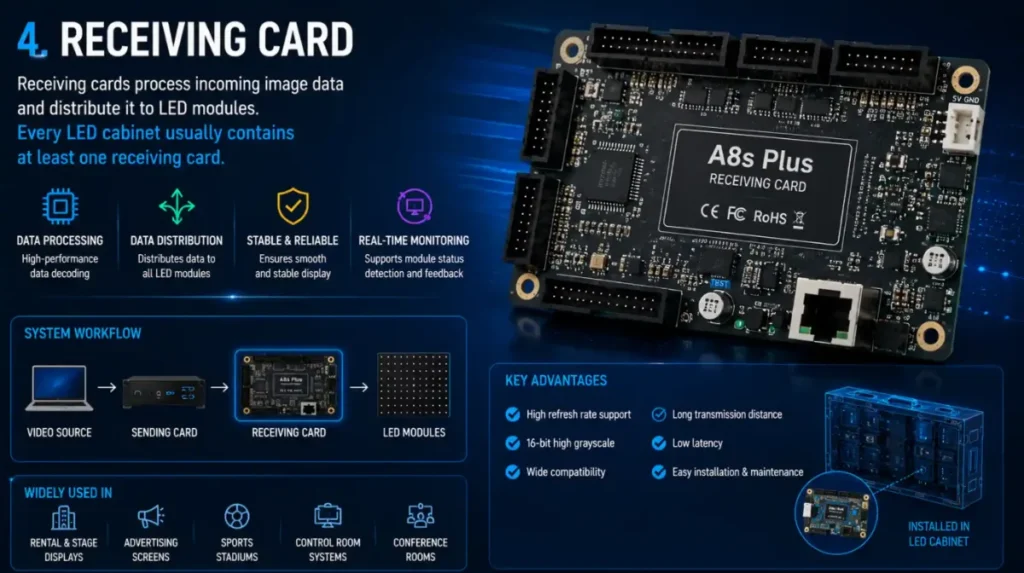
Receiving cards process incoming image data and distribute it to LED modules.
Every LED cabinet usually contains at least one receiving card.
Why Receiving Cards Are So Important
Receiving cards directly affect:
- rendimiento en escala de grises
- frecuencia de actualización
- uniformidad del color
- signal sincronización
Even small configuration errors may create:
- abnormal colors
- image disorder
- parpadeante
- mapping issues
Why Fine-Pitch Systems Require Better Receiving Performance
In applications such as:
- Producción de XR
- estudios de televisión
- centros de comando
- luxury conference rooms
receiving card performance becomes much more critical.
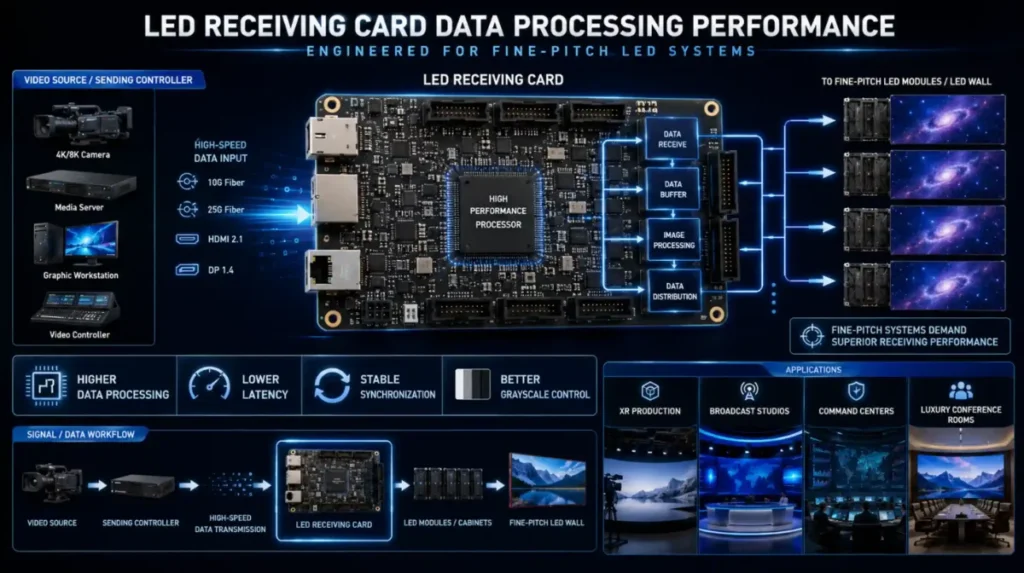
This is because fine-pitch displays require:
- higher data processing
- lower latency
- stable synchronization
- better grayscale control
Why Backup Systems Matter
Large projects often use:
- dual receiving card backup
- redundant signal loops
- fail-safe architecture
especialmente en:
- sistemas para estadios
- government command centers
- centros de control del transporte
DDW Engineer Notes: LED receiving card
Many troubleshooting attempts focus immediately on replacing modules.
However, signal mapping and receiving card configuration problems are often the real cause behind abnormal display behavior.
Key Receiving Card Specifications
| Specification | What It Means |
|---|---|
| Pixel loading | Max pixels per card (must cover the cabinet) |
| Data groups | Number of module data outputs |
| Driver IC support | Compatibility with high-refresh ICs |
| Grayscale / refresh | Image smoothness and camera performance |
| Calibration storage | Keeps point-by-point correction data |
| Monitoring / backup | Status feedback and dual-card options |
FAQ
What does a receiving card do in an LED screen?
It receives data from the sending card and drives the LED modules in its cabinet with correct timing, grayscale and calibration.
Can receiving cards from different brands be mixed?
Generally no; receiving cards must match the sending card or processor system.
What happens when a receiving card fails?
The cabinet or area it controls usually goes black or shows errors until the card is replaced and configured.
Related LED Display Guides
- NovaStar vs Colorlight comparison
- LED receiving card problems
- LED sending card guide
- LED screen calibration explained
- LED display backup and redundancy
Recommended DDW products: KCOB Series COB LED video wall · Pantalla LED de alquiler de la serie A