
Quick answer: Curved LED screens are built by joining cabinets with adjustable curve locks, typically in small steps (for example ±5° to ±15° per cabinet), to form concave or convex arcs. The minimum radius depends on cabinet width and lock range; flexible modules are used for tighter curves and cylinders.
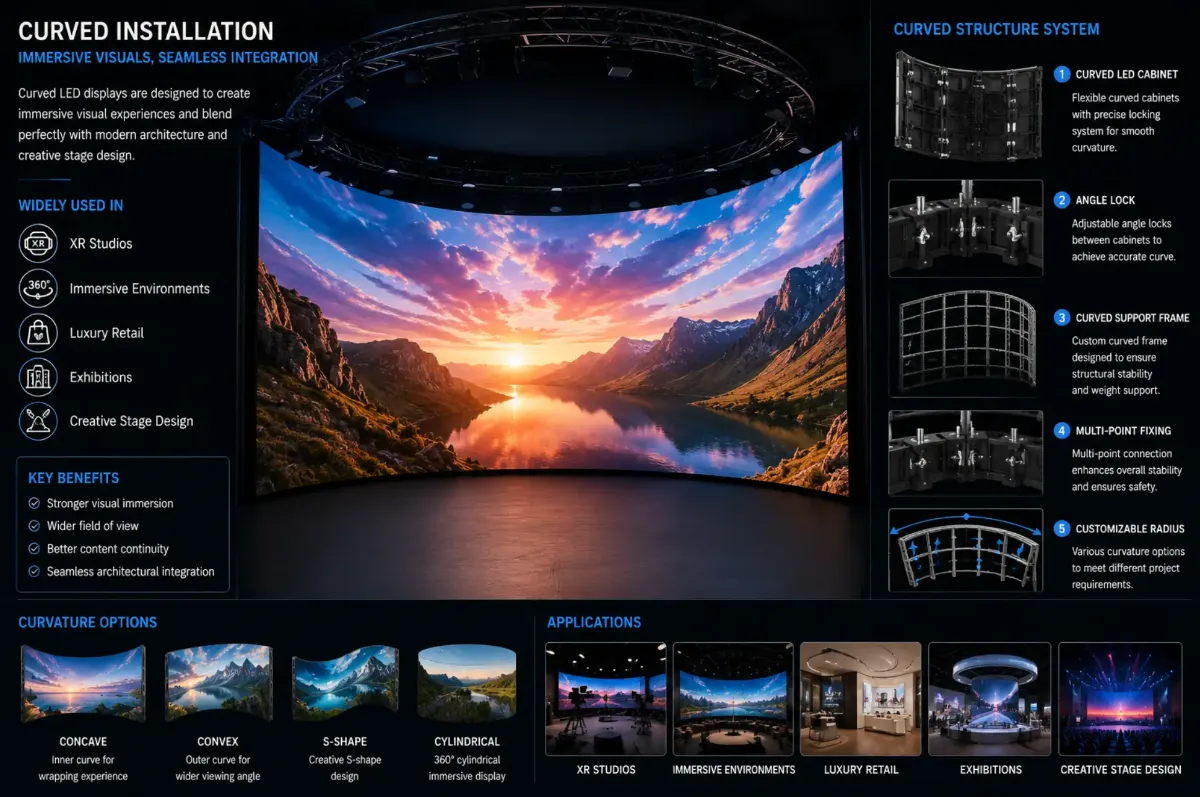
Curved LED displays are increasingly used in:
- XR studios
- immersive environments
- luxury retail
- exhibitions
- creative stage design
Curved structures help create stronger visual immersion and architectural integration.
Why Curved LED Installation Is More Difficult
Why Cabinet Design Matters in Curved Projects
Not all LED cabinets support curved installation equally well.
Professional curved systems usually require:
- dedicated curved locks
- flexible cabinet structures
- precision mechanical adjustment
This becomes especially important in:
- XR filming
- immersive museums
- luxury commercial visualization
Curved LED Installation Tips
- Plan the radius first: cabinet width ÷ angle per joint defines the arc; check it against the minimum radius.
- Concave vs convex: concave walls wrap the audience (XR, immersive rooms); convex walls suit pillars and exterior corners.
- Keep seams tight: small gaps become visible dark lines on curves.
- Use a curved frame for permanent installs so the arc stays accurate.
- Recalibrate brightness and color after installation.
DDW Engineer Notes: Curved LED screen installation
Many curved LED projects fail not because of image quality, but because of poor structural precision.
In immersive applications, visual continuity is often more important than simply achieving curvature.
FAQ
What is the minimum radius for a curved LED screen?
It depends on cabinet width and curve lock range. Standard cabinets often allow radii of a few meters; flexible LED modules can go much tighter.
Can any LED cabinet be curved?
No. Curved installation needs cabinets with curve locks or dedicated curved or flexible modules. Flat-only cabinets will leave gaps.
Is a curved LED screen good for XR studios?
Yes. Concave curved LED walls are standard in XR and virtual production because they surround the camera with consistent background imagery.
Related LED Display Guides
- Hanging LED screen installation
- Wall-mounted LED display installation
- LED screen cabinet materials
- Front service vs rear service LED display
Recommended DDW products: AFlex Series curved rental LED display · ORBIT XR Series XR LED wall