
Quick answer: An outdoor LED display structure is usually a hot-dip galvanized steel frame designed for local wind load, the screen weight and maintenance access. It should include a service walkway (about 0.8 m) for rear-service screens, ventilation or air conditioning, lightning protection and proper grounding.
Outdoor LED structures must survive long-term exposure to:
- sunlight
- rain
- wind
- humidity
- dust
- temperature variation
This makes outdoor engineering significantly more demanding than indoor installations.
Why Outdoor Structures Require Engineering Calculation
Large outdoor displays generate significant structural pressure.
Professional projects usually require analysis of:
- wind load
- structural stress
- foundation stability
- cabinet weight
- installation angle
Especially in:
- coastal regions
- high-wind environments
- Middle East projects
structural engineering becomes extremely important.
Why Ventilation Is Often Ignored
Many outdoor projects focus heavily on waterproofing while ignoring ventilation.
Poor airflow may accelerate:
- power supply aging
- internal heat accumulation
- electronic failure
This is especially critical for:
- high-brightness billboards
- enclosed structures
long-hour operation systems
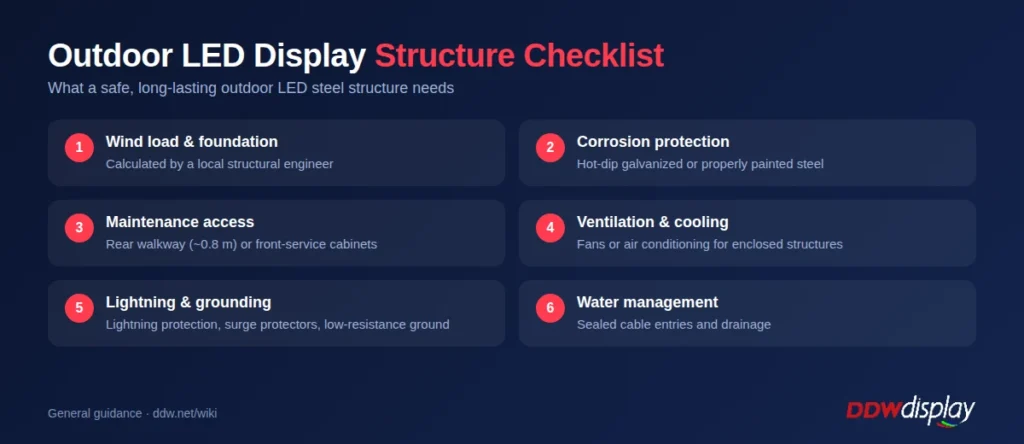
Outdoor LED Structure Design Checklist
- Get wind load and foundation calculations from a local structural engineer.
- Use hot-dip galvanized or properly painted steel to resist corrosion.
- Include a rear maintenance walkway or choose front-service cabinets.
- Plan ventilation, fans or air conditioning for enclosed structures.
- Install lightning protection and ground the structure (typically ≤ 4 Ω).
- Seal cable entries and add drainage to keep water out.
DDW Engineer Notes: Outdoor LED display structure
Outdoor LED engineering is never only about the screen itself.
Long-term reliability depends heavily on:
- structural design
- ventilation planning
- drainage systems
- maintenance accessibility
Many outdoor failures are actually engineering problems rather than display problems.
FAQ
What steel is used for outdoor LED display structures?
Most outdoor LED structures use hot-dip galvanized carbon steel sized by a structural engineer for local wind and snow loads.
Does an outdoor LED screen need air conditioning?
Large enclosed outdoor LED displays in hot climates often need fans or air conditioning to keep internal temperatures safe.
How is an outdoor LED billboard protected from lightning?
With a lightning rod or air terminal, surge protectors on power and signal lines, and a low-resistance grounding system.
Related LED Display Guides
- LED screen IP rating
- LED screen power distribution guide
- LED display moisture protection
- Ground support LED screen installation
- Front service vs rear service LED display
- LED screen installation cost and timeline
Recommended DDW products: FA Series outdoor LED screen · FC Series energy-saving outdoor LED screen