
Quick answer: An LED sending card converts the video signal from a PC or source into LED data and sends it over network ports to the receiving cards. Each 1 Gbps port drives roughly 650,000 pixels; large screens need multiple ports or processors, with fiber for long distances and backup loops for reliability.
Sending Card
Colorlight is another major LED control system platform widely used in:
- commercial LED projects
- outdoor advertising
- conference systems
- transportation displays
- command centers
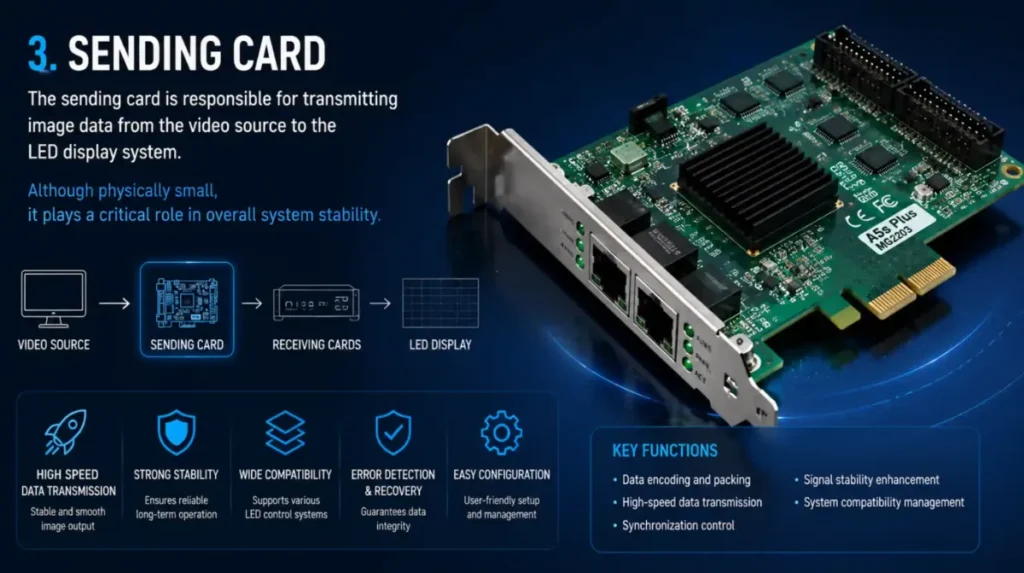
What Sending Cards
Actually Do
Sending cards handle:
- signal conversion
- image transmission
- synchronization control
- communication with receiving cards
If sending card configuration becomes unstable, the display may experience:
- image tearing
- black screens
- synchronization issues
abnormal refresh behavior
Why Large Projects Require Advanced Sending Systems
Large LED systems often involve:
- multiple processors
- fiber transmission
- backup architecture
- synchronized playback
This is especially common in:
- stadium displays
- XR stages
- broadcast production
- large concerts
Why Redundancy Matters
High-end projects increasingly use:
- dual backup sending cards
- redundant signal paths
- failover systems
This helps prevent full system interruption during critical operation.
DDW Engineer Notes: LED sending card
Many display failures during live events are not caused by LED modules themselves.
Signal architecture instability is often the real issue behind temporary system interruptions.
Professional system redundancy becomes extremely important in mission-critical environments.
Sending Card Capacity and Setup
| Item | Typical Value / Guidance |
|---|---|
| Per 1G port | About 650,000 pixels (60 Hz, standard bit depth) |
| Cable | Cat5e/Cat6 up to about 100 m; fiber beyond |
| Inputs | DVI/HDMI from PC or source |
| Redundancy | Backup loop and hot-standby cards |
| When to upgrade | Multiple inputs or scaling → video processor |
FAQ
How many pixels can a sending card drive?
It depends on the number of ports; each 1 Gbps port typically drives about 650,000 pixels.
What is the difference between a sending card and a video processor?
A sending card only converts and sends data; a video processor adds scaling, input switching and multi-window features, often with built-in sending ports.
Can a sending card send signal over long distances?
Yes, using fiber converters or fiber-output controllers for runs beyond about 100 m.
Related LED Display Guides
- NovaStar vs Colorlight comparison
- LED video processor guide
- LED receiving card guide
- LED display signal connection guide
- LED display signal loss troubleshooting
Recommended DDW products: A Series rental LED display · D Series rental LED screen